A glossary for reading a card: ATS, moneyline, puck line, juice, push, hook, and key numbers
A card on this site is written in shorthand. ATS, ML, PL, a minus price, a half point, a line of 3.5: each term carries one precise meaning. This glossary defines them using locked lines and final scores from recent games in the site feeds.
ATS: against the spread
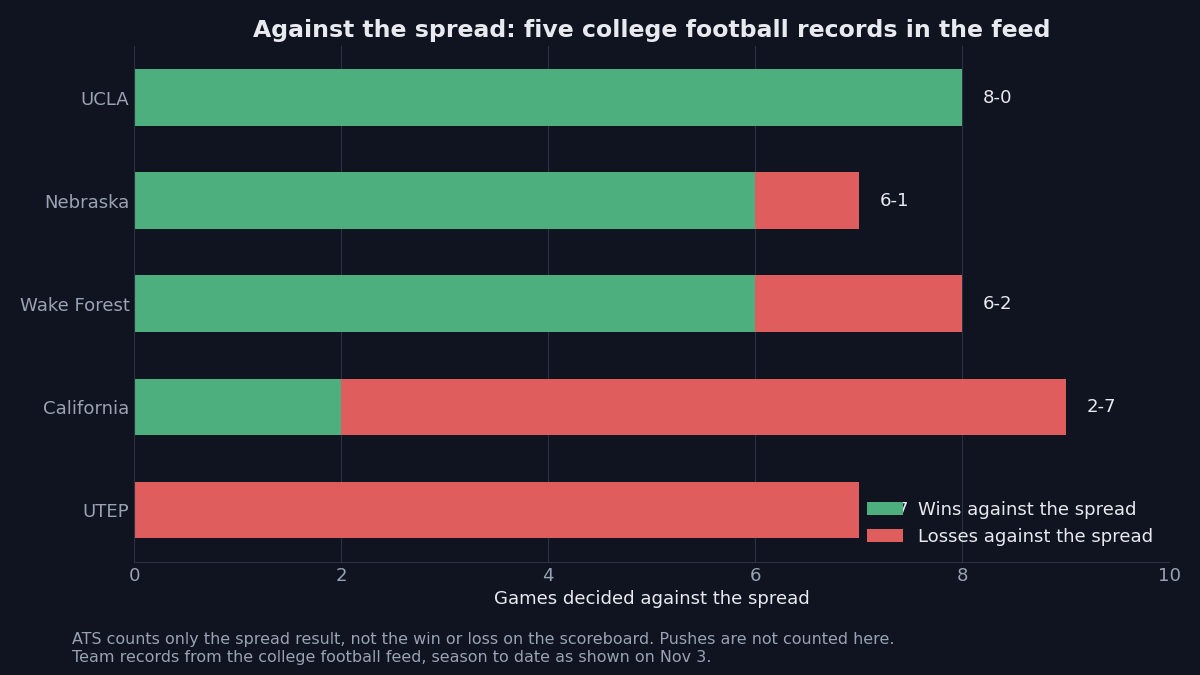
ATS means against the spread. A team record ATS counts only spread results, not wins and losses on the scoreboard. A team can win a game and still lose ATS, if it wins by less than the spread asks for. A team can lose a game and still win ATS, if it loses by less than the spread allows.
The college football feed carries a team record ATS for every team. UCLA stood at 8-0 ATS, Nebraska at 6-1, and Wake Forest at 6-2, while California stood at 2-7 and UTEP at 0-7.
Spread, hook, push, and key numbers
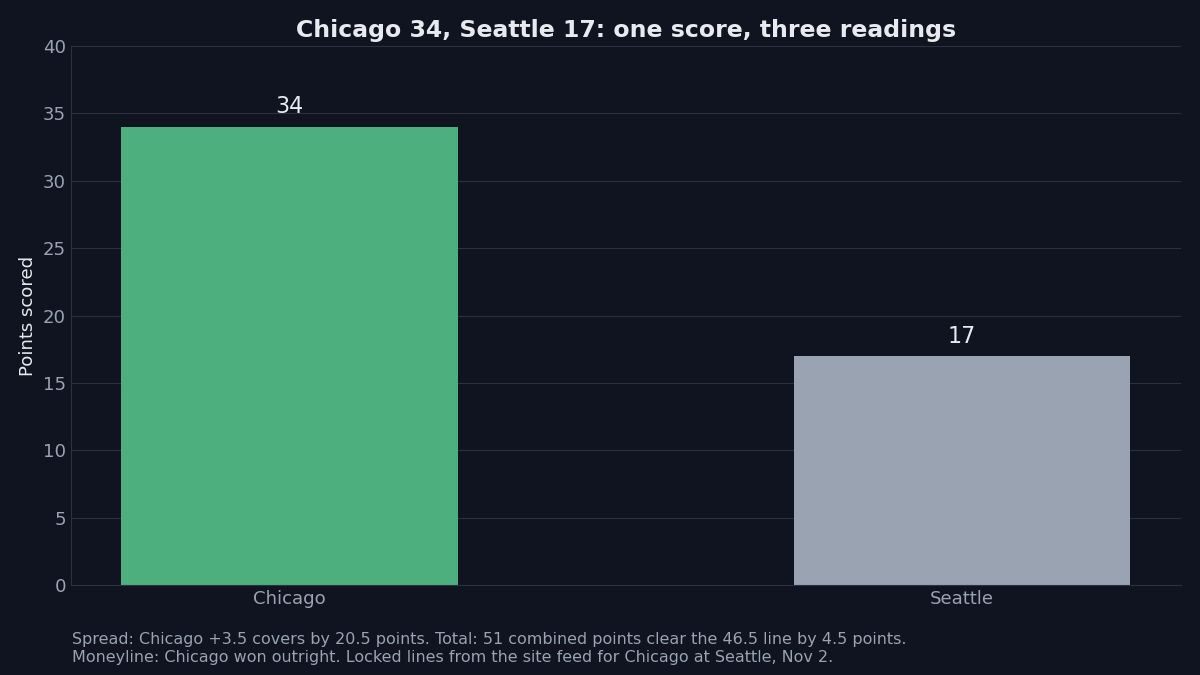
A spread is a handicap in points. Chicago at Seattle on November 2 locked with Seattle -3.5 and Chicago +3.5. The minus side is the favorite: Seattle had to win by 4 points or more to cover. The plus side is the underdog: Chicago covered with any win, and with a loss by 3 points or fewer. Chicago won 34-17, so Chicago covered by 20.5 points on the adjusted score.
The .5 in 3.5 is the hook: a half point added so the result cannot land exactly on the number. With a hook, there is a winner and a loser, and no middle result. Without a hook, a line can push. A push happens when the final margin lands exactly on a whole-number line: a favorite at -3 that wins by exactly 3 points neither covers nor fails to cover, and the line settles as neither a win nor a loss.
Key numbers are the margins that happen most often in football, and 3 and 7 head the list. Three points is a field goal. Seven points is a touchdown with the extra point. A line moving from 3 to 3.5, or from 7 to 7.5, crosses a common final margin, so that half point carries more weight than a half point between less common margins, such as 4.5 to 5.5.
Total: one number for both teams
A total asks about combined scoring, not about who wins. Chicago at Seattle locked at 46.5 points. Over needed 47 points or more. Under needed 46 points or fewer. The final score added to 51 points, so Over won by 4.5 points over the line. The total does not care that Chicago won by 17 points. It cares only that the two scores added to 51.
Hockey totals work the same way, with smaller numbers. Vegas at Boston locked at 6.5 goals. The final score was Boston 3, Vegas 2, for 5 goals in total, so Under 6.5 won. A total with a hook cannot push, just as a spread with a hook cannot push.
Moneyline and juice
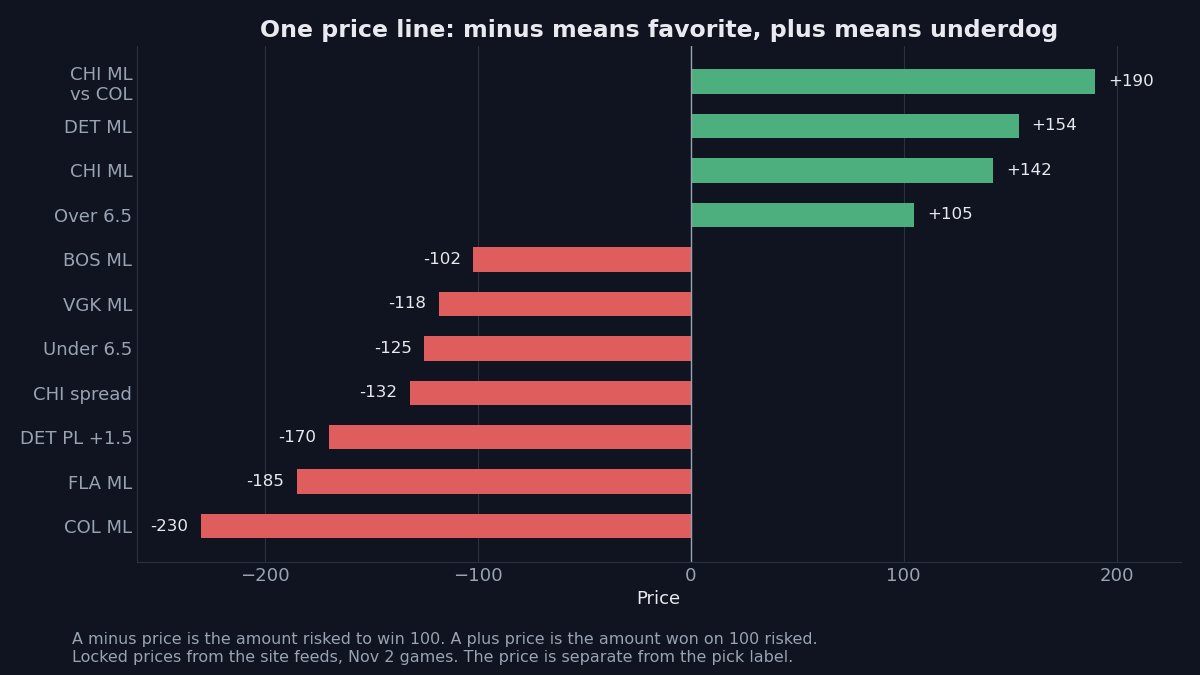
ML means moneyline. A moneyline asks only who wins outright, with no spread and no total. Chicago at Seattle locked with Chicago at +142, and Detroit at Florida locked with Detroit at +154. A plus price is an underdog price: risk 100 and a win returns that plus number as profit. A minus price is a favorite price: risk the minus number to win 100, so Colorado at -230 meant risking 230 to win 100, and Florida at -185 meant risking 185 to win 100.
Juice is the price charged for a line, shown in the same minus or plus number. Most spread and total lines sit near -110 on both sides, meaning 110 risked to win 100. Chicago +3.5 locked at -132, heavier juice than -110: 132 risked to win 100. Read the price for the return, and read the line for the question being asked.
Puck line: hockey with a spread
PL means puck line. A puck line is hockey's spread, and it almost always sits at 1.5 goals. Detroit at Florida locked with Detroit PL +1.5 at -170. Detroit won 5-3, so the puck line won as well. The +1.5 side also wins when its team loses by exactly 1 goal, because adding 1.5 goals turns a 1-goal loss into a win on the adjusted score.
The -1.5 side needs a win by 2 goals or more. Vegas at Boston locked with Vegas PL -1.5 at +210. Boston won 3-2 in a shootout, a margin of 1 goal, so Vegas PL -1.5 lost even though the game was close. Colorado at Chicago locked with Colorado PL -1.5 at +110, and Colorado won 5-2, so that puck line won. The same 1.5 number asks a different question by sign: +1.5 gives room for a narrow loss, and -1.5 demands a clear win.
Reading a line in order
Read a game page in the same order every time. Read the market first: spread, total, moneyline, or puck line, and the number attached to it. Read the side second: favorite or underdog, Over or Under, plus or minus on the puck line. Read the price third, for what a win returns and how much juice the line carries. Read the hook fourth: a half point means no push is possible, and a whole number means a push is possible when the margin or the combined score lands exactly on the line.
A spread asks by how much. A total asks how many. A moneyline asks who. A puck line asks by how much in a low-scoring game. Juice asks what the price costs. With those terms settled, a card reads as a set of clear questions, each with a locked line, a locked price, and a score that answers it.
21+. If gambling stops being fun, call or text 1-800-GAMBLER.