Goaltending in hockey: how one name in net moves a moneyline and a total
In hockey, one player is on the ice for all 60 minutes and faces every shot the other team puts on net. That is why the goalie is the biggest single-player input on a hockey card. Change the name in net and two numbers move: the win chance and the total. Here is how the model reads a goalie.
What the model reads on a goalie
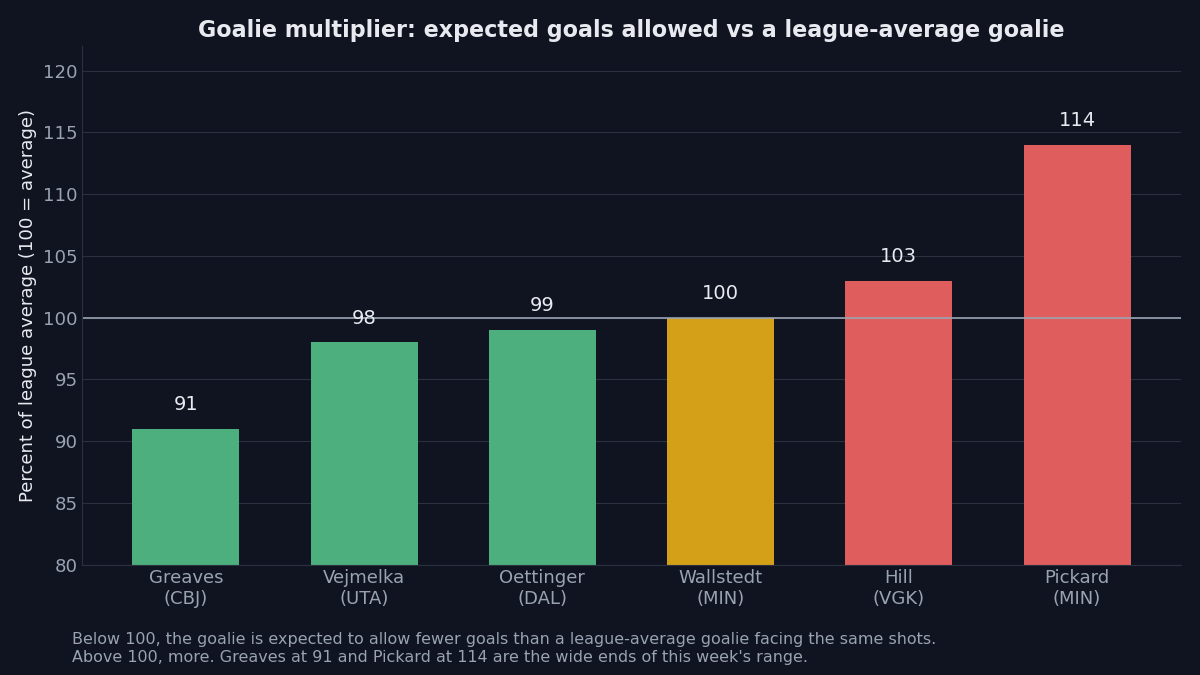
Three entries carry the goalie on every card. The first is a multiplier on a 100 scale: below 100, the goalie is expected to allow fewer goals than a league-average goalie facing the same shots; above 100, more. Greaves of Columbus carries 91, Pickard of Minnesota 114, and most starters sit within a few points of 100. The second entry is a start chance. Until a starter is confirmed, the card blends the candidates by how likely each is to play. The third entry is the goalie line in the why breakdown, the goals it adds to or subtracts from a team's expected total.
Dallas at Columbus: a backup changes the number
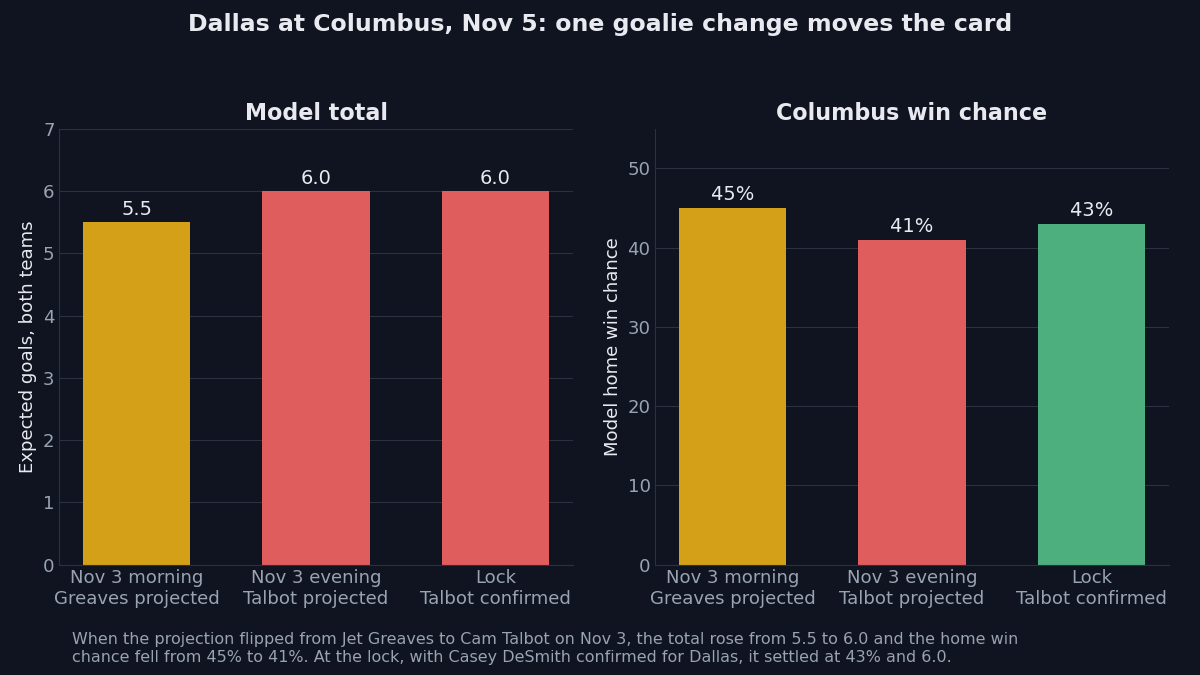
The clearest example came on Nov 5, when Dallas visited Columbus. On the morning of Nov 3, Jet Greaves was projected in net for Columbus, and the card read a 45% home win chance with a model total of 5.5. By that evening, the projection had flipped to Cam Talbot, and the card read 41% and 6.0. At the lock, Talbot confirmed for Columbus and DeSmith confirmed for Dallas, it settled at 43% and 6.0. One name, half a goal on the total, 4 points on the win chance. The scenario read is plain: Greaves in net, Columbus is a 49% home side; Talbot, 44%. Greaves carries 91, Talbot 100, and that gap is the whole move.
The game itself went the other way. Columbus won 2-1 in a shootout, and both Dallas leans lost: the moneyline at -130 for -1.00u and the puck line at +195 for -1.00u. The goalie move was real; the result still went the other way. A goalie changes the number. The number is a price, not a result.
Montreal and Utah: a small move, and a bigger one on the other side
Not every goalie change moves the card by the same amount. On Nov 5, Montreal hosted Utah with Jacob Fowler projected in net. When Jakub Dobes was confirmed instead, the home win chance moved from 50% to 49% and the model total stayed at 6.5. Almost nothing. The two goalies carry nearly the same multiplier, 99 and 100, and the card barely noticed the swap. The away side told a different story. With Karel Vejmelka in net for Utah, the model total read 6.5; with Sebastian Cossa, it read 7.0, and the home win chance read 45% instead of 44%. Same game, same night: the backup on one side was worth half a goal on the total, the starter change on the other side almost nothing.
Montreal won 5-4 in overtime, 9 goals in all, and none of the three leans carried a strength label, so nothing on it was graded. The why breakdown shows the split: facing Utah's goalie added a sliver to Montreal's expected goals, while facing Montreal's goalie pulled about a quarter of a goal off Utah's expected total.
Tonight: Minnesota and San Jose
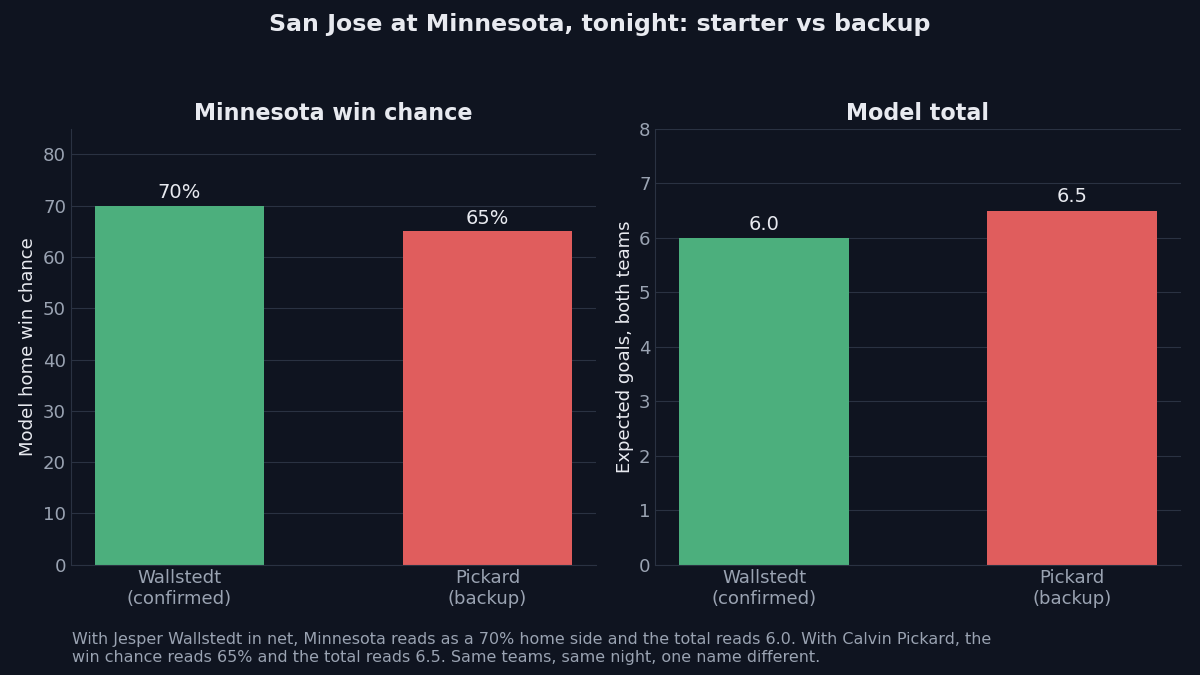
Tonight's card carries the same read. San Jose visits Minnesota, Jesper Wallstedt confirmed in net with a 91% start chance in the model's blend. With Wallstedt in net, Minnesota reads as a 70% home side and the model total reads 6.0. With Pickard instead, 65% and 6.5. The gap is the multiplier: 100 against 114. On the other side, Nedeljkovic reads 68% and 6.5, Askarov 69% and 6.5, a swap that barely registers. The market has Minnesota at -270 with a total of 6.5; the blended card reads 72% against a 70% market number.
What a goalie change does not do
A goalie is one line in a build that starts from a league base near 2.5 goals per team, then adds offence, defence, lineup, rest, and finishing. Detroit against Vegas on Nov 5 is the quiet version: Tarasov and Gibson read 43% and 42%, both with a model total of 6.0, and Hart and Hill 43% and 44%. The Under 6.5 on that card won at +0.69u as the game finished 2-1, and the goalie names were a footnote.
A famous name is not a system either. The trend rows for Dallas at Columbus carry a goalie-matchup band, games where the other side has an elite goalie in net: 12-18, -4.70u. Reputation draws attention; the record in that band is a losing one. Read the multiplier and the start chance, not the name on the back of the jersey.
How to read the goalie line on a card
Three checks, in order. First, starter status: confirmed means the name is set, likely means it is close, projected means the model is still blending. Second, start chance: a 90% starter is priced almost entirely on one goalie, while a 60/40 split leaves the card halfway between two of them until the lock freezes it. Third, the goalie line in the why breakdown: read it in goals, next to the team offence and defence lines. If it is the biggest line in the build, the name in net is doing the work. If it is a sliver, the teams are.
Check the goalie first on every hockey card. Then read the rest of the build: the goalie is one line among many, worth half a goal on the nights it matters and almost nothing on the nights it does not.
21+. If gambling stops being fun, call or text 1-800-GAMBLER.