How a pick is graded: wins, losses, pushes, and what the price does to the result
Every pick on this site ends in one of three words: win, loss, or push. The record carries all three, in that order, like the NFL card at 87-94-1 through November 10. The part most readers miss is that a win is not always worth the same amount. The price on the pick decides what a win pays. A loss always costs one unit, whatever the price was. A push costs nothing and pays nothing. That asymmetry is the reason the record is kept in units instead of wins and losses: the win-loss count alone does not say how the card is doing. Unit figures below are rounded to the nearest half point.
What a win pays depends on the price
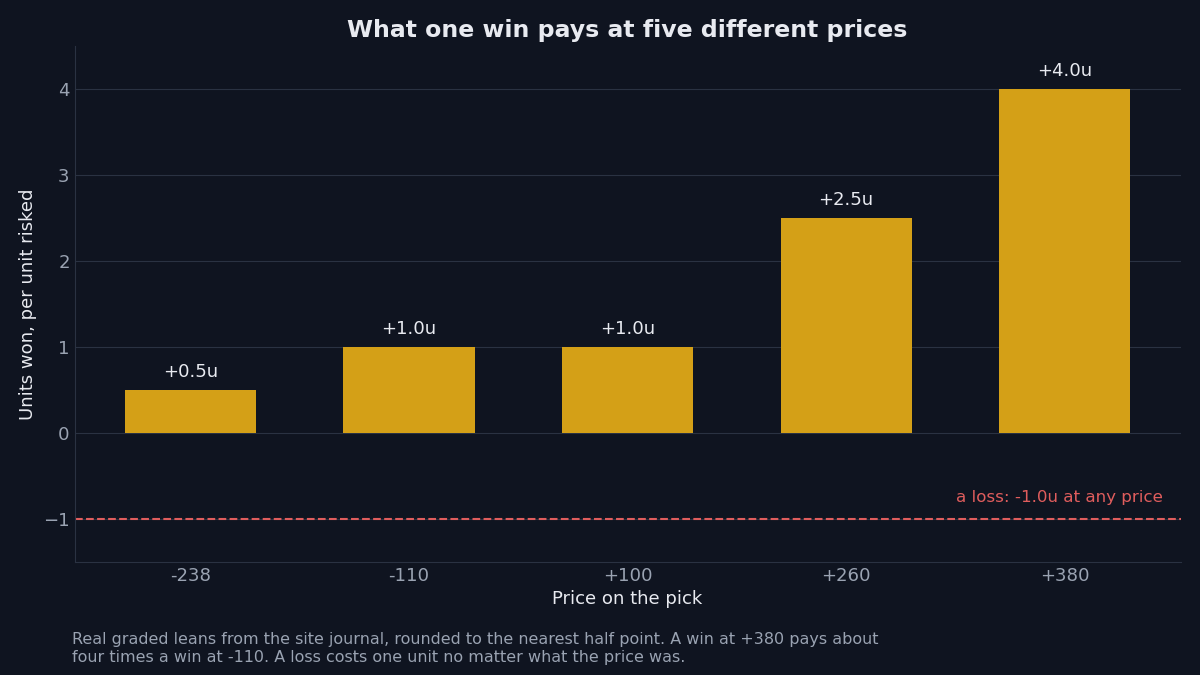
A spread or a total at -110 is the standard price on this site, and a win there returns just under one unit for every unit risked, shown as +1.0u here. At +100 the win returns exactly one unit. The moneyline is where the price spreads out. A win on New England at +260 in Buffalo returned +2.5u, and a win on Tampa Bay at +380 in Dallas returned +4.0u. At the other end, a win at -238 returns about half a unit. The chart below shows the ladder: the price is the payout, and the same win is worth very different amounts at different prices.
What a loss costs is always the same
One unit. Baltimore plus 9.5 at -110 lost on Thursday night, 33-10 against Jacksonville: -1.0u. Over 39 in Green Bay at Tampa Bay lost: -1.0u. The price changes nothing on the losing side. A loss on a +380 moneyline costs the same one unit as a loss at -110. The price only changes what a win pays. That is why a 50% win rate at -110 is a losing record in units: 50 wins at -110 return about +45.5u while 50 losses cost -50u, leaving the card about -4.5u down. The break-even win rate at -110 sits at about 52.5%, which is the bar the site tests every idea against before it goes near the card.
What a push is
A push is a tie against the number. For a spread or a total, the final score lands exactly on the line: a favorite of 3 winning by exactly 3, or a total landing exactly on 43. For a moneyline, a push needs a tie game, which is rare in the NFL but happens: the Giants and Washington tied 27-27 on October 11, and the moneyline lean on that game graded as a push, with no units won or lost. That is the "1" in the NFL record of 87-94-1, the only push on the graded card so far this season. Pushes are rare here for a second reason: most locked spreads sit on half points, and a final margin cannot land on a half point. A push counts in neither the win column nor the loss column. It returns the unit, so the record is unchanged.
How the season record reads in units
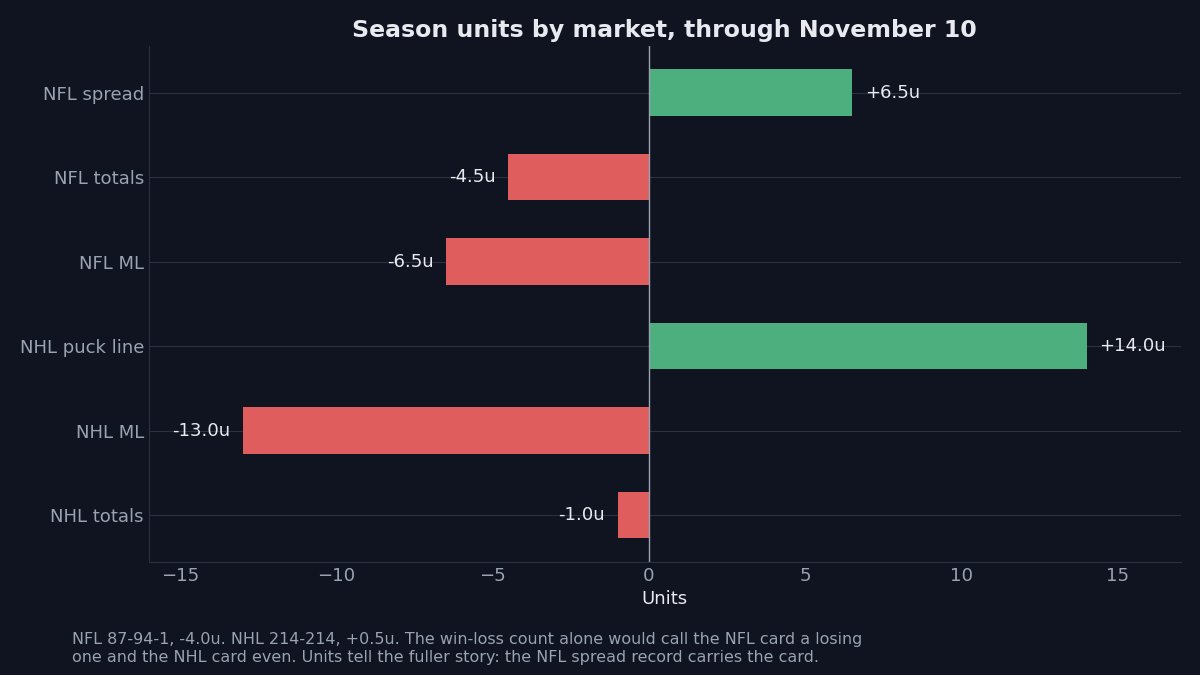
The NFL card through November 10 is 87-94-1, -4.0u. Fewer wins than losses, but only -4.0u down, because the wins include plus-money moneylines that pay +2.5u and +4.0u. The NHL card is 214-214, +0.5u: an even win-loss count, slightly positive in units. By market, the story splits. The NFL spread record is 33-23 for +6.5u and carries the card, while totals sit at -4.5u and moneylines at -6.5u. In hockey the puck line is +14.0u on 54-52 while the moneyline is -13.0u and totals are -1.0u. The win-loss count alone would call the NFL card a losing one and the NHL card even. Units show which markets are doing the work.
Seven real graded leans
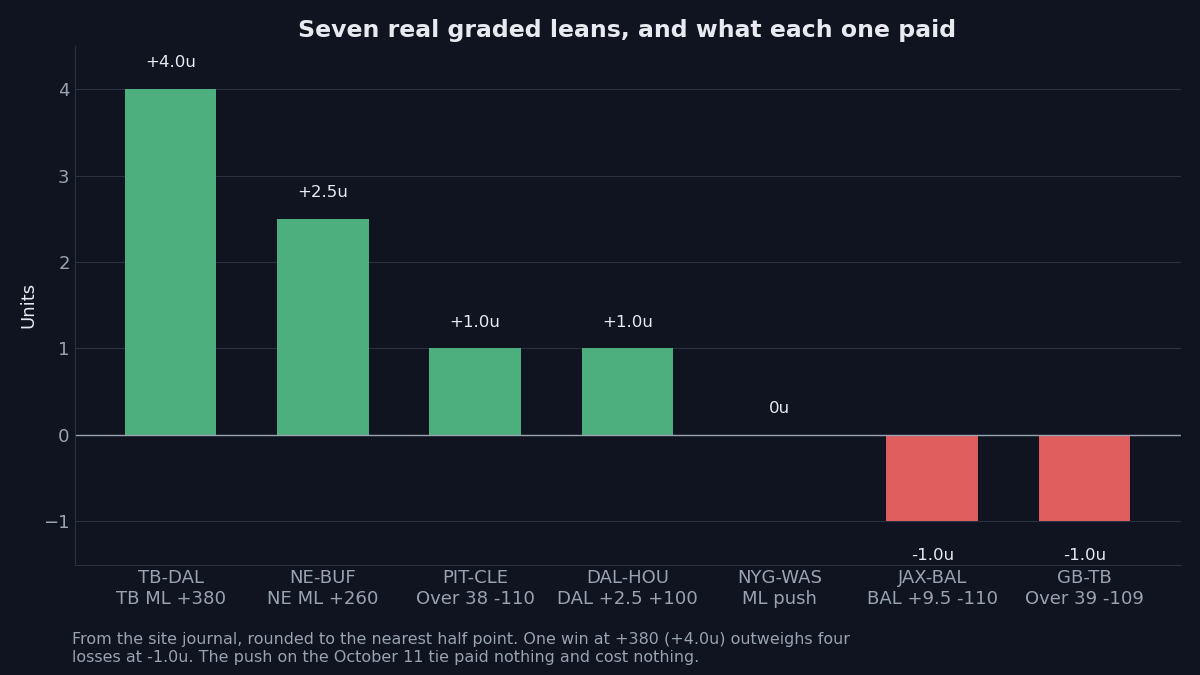
The chart below puts seven real leans from the journal side by side: four wins, two losses, one push. The Tampa Bay moneyline win at +380 paid +4.0u, which outweighs four losses at -1.0u on its own. The New England moneyline win at +260 paid +2.5u. The two ordinary wins, Over 38 in Pittsburgh at Cleveland at -110 and Dallas plus 2.5 at Houston at +100, each added about +1.0u. The two losses, Baltimore plus 9.5 and Over 39 in Green Bay at Tampa Bay, each cost -1.0u. The push on the October 11 tie added nothing. Add the seven together and the record reads 4-2-1 for +6.5u. The record says 4-2-1; the units say +6.5u. Both are true, and the units say more, because the prices were part of every one of those picks.
Why grading uses the locked line
A pick is graded at the line and the price it locked at, two hours before kickoff, not at the closing line. The journal keeps the locked number and the locked price, so anyone can check the grading: the line, the price, the result, the units. A line that moves after the lock does not change the grade. That is the point of the lock, and the reason the record can be read the same way months later. When you read a record on this site, read the units first. The wins and losses tell you how often the model was right. The units tell you what that was worth, at the prices the model actually carried. A 4-2-1 week can be worth +6.5u or +1.0u depending on the prices, and a 50% win rate can still be a losing card. The price is part of the pick.
21+. If gambling stops being fun, call or text 1-800-GAMBLER.