How football power ratings are built — and how to read a rating change
Every matchup page on this site shows a margin, and under it a short breakdown: home field, offense, defense, quarterbacks, other factors. Those five lines are the power rating in plain sight. A power rating is one number per team, and the margin is the difference between the two teams' numbers, plus home field. This piece walks through the five parts with real games from this week's NFL feed.
One number per team, five parts per game
Jacksonville at Baltimore, Nov 5, is the cleanest worked example of the week. The model had Jacksonville by 7. The breakdown, from Baltimore's side of the page: home field +0.5, offense -2.0, defense -2.5, quarterbacks -3.5, other factors +0.5. A positive part helps the home team, a negative part helps the visitor. Baltimore's home field was worth half a point, its offense 2 points less than Jacksonville's, its defense 2.5 less, and its quarterbacks 3.5 less. The other factors line gave half a point back, and the margin is Jacksonville by 7.
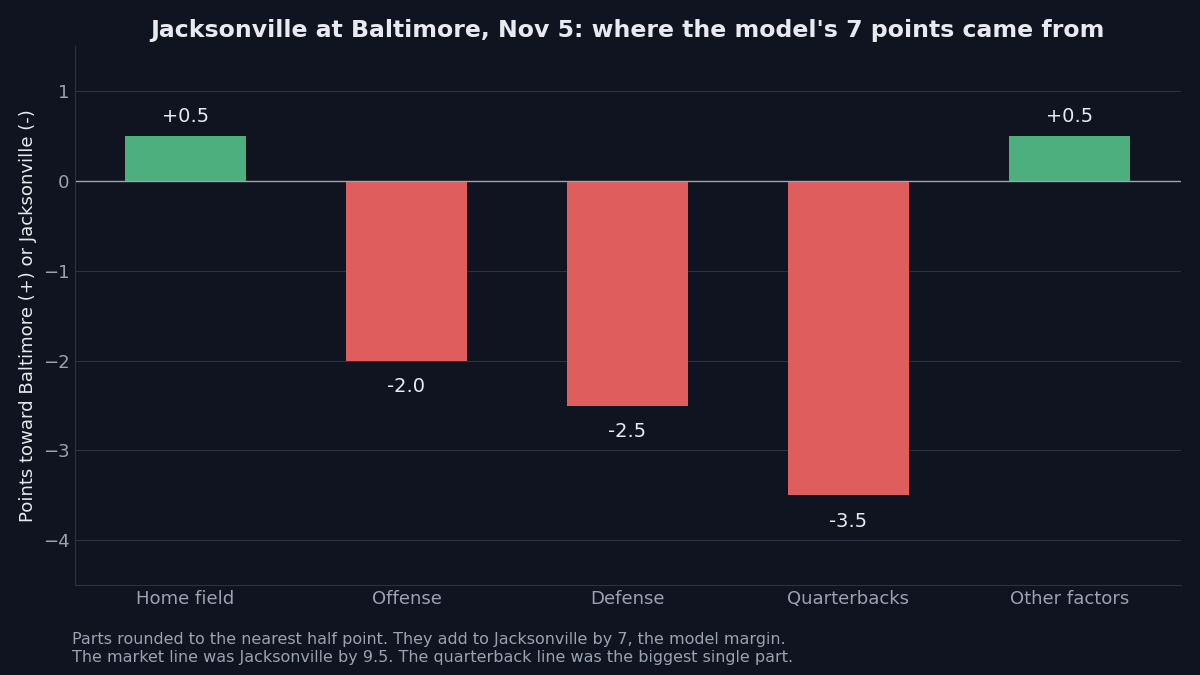
Two things about that list are worth keeping. First, home field is the smallest line on the card: 0 to half a point across this week's games, and the neutral-site game in the Sunday window, New England at Detroit, carries no home-field line at all. Second, the parts are a difference, not a grade. An offense line of -2.0 does not say Baltimore's offense is bad. It says it is 2 points worse than the offense across from it.
The quarterback line is the one that jumps
Of the five parts, the quarterback line moves the most, and the fastest. In the Jacksonville game it was the biggest single part: 3.5 points. Baltimore's starter, Lamar Jackson, was out, and the backup, Joe Fagnano, carried a value 3.5 points below a usual starter. One name in the lineup was worth 3.5 points — more than any other single part, and more than home field and the other factors combined.
Sunday's card has the same shape in Seattle at Las Vegas, where the quarterback line is -4.0: Fernando Mendoza starts for Las Vegas after the trade that sent Kirk Cousins to Minnesota. The defense line there is even bigger, -7.0, which brings us to the next point.
Offense and defense do the heavy lifting
Most weeks, the margin comes from the two lines in the middle. Sunday's card shows how different the mix can be from game to game.
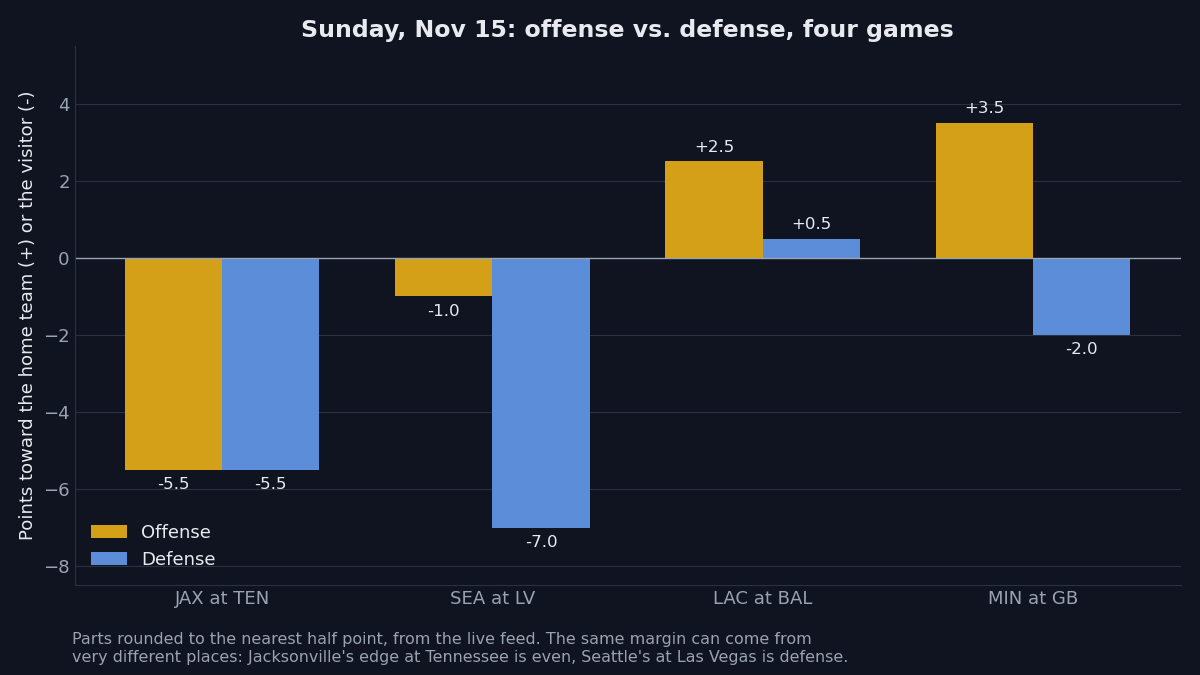
Jacksonville at Tennessee is even: offense -5.5, defense -5.5, for a model margin of Jacksonville by 11. Seattle at Las Vegas leans on one side: offense -1.0, defense -7.0, for Seattle by 11. Baltimore against the Chargers: offense +2.5, defense +0.5, Baltimore by 4.5. Green Bay: offense +3.5, defense -2.0, quarterbacks -3.0, Minnesota by 2.5.
The same margin can be built from very different teams, and the breakdown tells you which kind of game you are looking at before kickoff.
Ratings move a little at a time
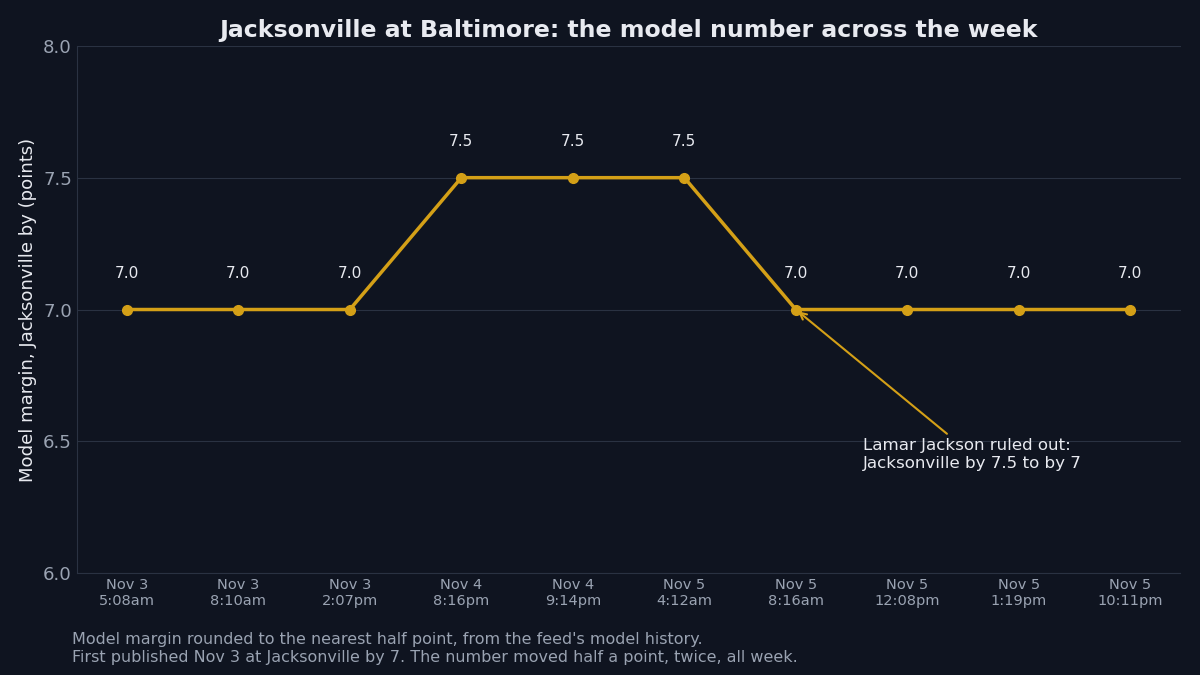
A rating is a summary of everything a team has done, so one game moves it a little, not a lot. Jacksonville at Baltimore shows the pace. The model number was first published on Nov 3 at Jacksonville by 7. It drifted to 7.5 across Nov 3 and 4, then moved back to 7 on the morning of Nov 5, when Lamar Jackson was ruled out. Two half-point moves in three days, and the number never moved more than half a point at once.
Washington at New York moved the same way: the Giants by 2.5 on the morning of Nov 11, by 2 that evening, and it stayed there. The game finished Washington 24-21. A half-point move during the week is routine. A move of several points means a starter changed, and the quarterback line is usually where it shows up.
One game does not rebuild a rating. Jacksonville beat Baltimore 33-10, a wider margin than the model's 7 or the market's 9.5. That result goes into the rating as one game among many. The rating's job is to be stable enough that one afternoon does not rewrite it.
How to read a rating change
Three habits cover most of it.
First, look at which part moved. If the quarterback line moved, a starter changed, and that is the move that matters most. If the offense or defense line moved, a team's form moved, absorbed slowly.
Second, read the size. Half a point is noise and news. A point or more is a real change in what the model thinks. Three points or more, and something structural changed: a quarterback, a cluster of injuries, a team the model had wrong.
Third, compare the rating with the market. Jacksonville at Tennessee: the model has Jacksonville by 11, the market has Jacksonville by 10.5, and the fair spread sits at 11. The two numbers nearly agree, and the card carries no strength label on the spread. Seattle at Las Vegas: the model has Seattle by 11, the market has Seattle by 6.5, and the fair spread sits at 11. That 4.5-point gap is why the card labels Seattle -6.5 moderate. The gap is the story; the rating on its own is only half of it.
A power rating is not a ranking and not a prediction. It is a summary, in points, of what a team has shown, split into five lines so a reader can see where the number comes from. Read the parts, watch which one moves, and let the gap between the rating and the market do the talking.
21+. If gambling stops being fun, call 1-800-GAMBLER.