How line movement works: what a moving line is telling you, and what it is not
A line is a price. It opens at one number, and it moves as news arrives and as money arrives. The market number can move, the model number can move, and the two do not always move together. A move tells you that something changed. It does not tell you how the game will end, and it does not change a pick that has already locked.
A line moves in three ways
A move can change the price without changing the number: a moneyline moves from -125 to -115 while the spread and the total stay where they were. A move can change the number without changing the price much: a total moves from 47.5 to 50.5 while the price on each side stays near the same level. And a move can change both at once, when a piece of news is large enough to reprice the whole game.
The number decides what counts as a cover or an over on spreads and totals. The price decides the return at the locked line on moneylines and puck lines.
Before the lock, the card can change as the line and the model change. At the lock, two hours before the game starts, the pick freezes at the locked line, whatever the line does after that.
News moves a line first: Cincinnati at Baltimore
The clearest move of the week came with a change at quarterback. The feed recorded Baltimore starter Lamar Jackson changing to Tyler Huntley. In the same round of updates, the spread moved from Baltimore -3.5 to Baltimore -1.5, a move of 2 points, and the total moved from 51.5 to 50.5, a move of 1 point. The model margin moved too, from about 4 points for Baltimore to about a pick'em.
News can move both numbers at once, and it can move the model as well as the market, because the model uses the same news. The gap between the two numbers changed, and with it the card changed before the lock. None of that means the new number is right. It means the information changed, and both sides repriced on it.
A total can move while the spread stands still: New England at Chicago
New England at Chicago opened with a spread of 1.5 and a total of 47.5. The locked line kept the spread at 1.5 and moved the total to 50.5, a move of 3 points. The model total sat at about 45. The market moved toward more scoring, away from the model number, while the spread did not move at all.
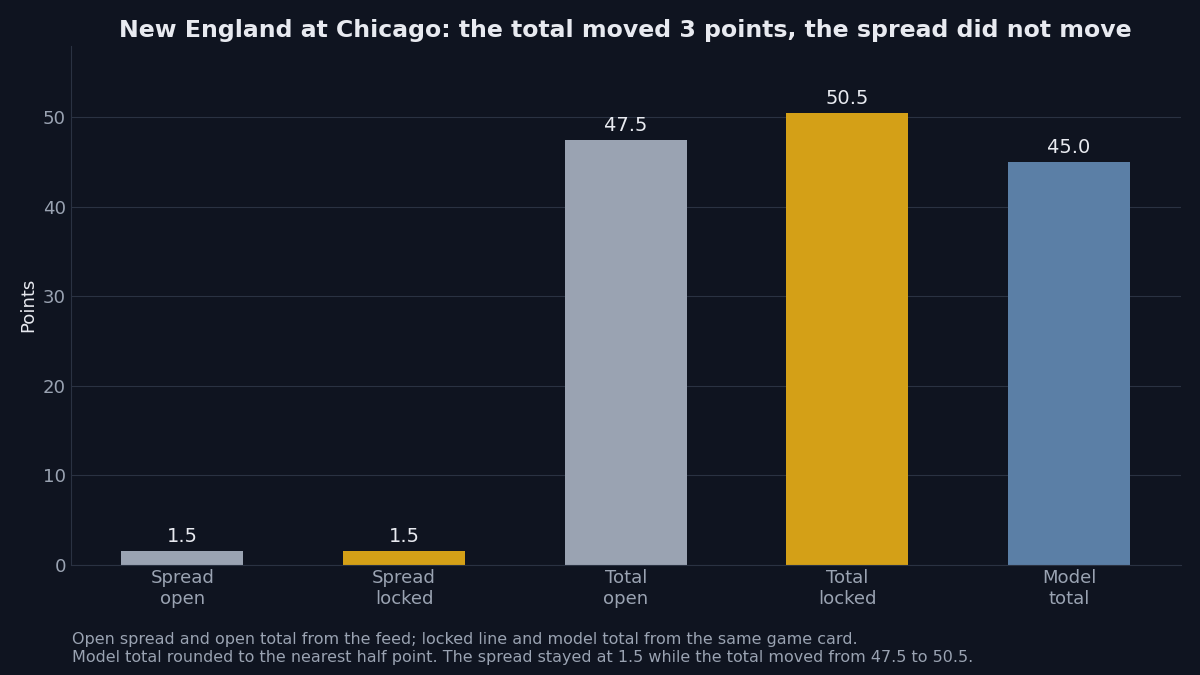
Graded at the locked line, the spread pick was a win and the total pick was a loss. The move set the bar the total had to clear, at 50.5 rather than at the opening 47.5, and the final total cleared it.
A move against the model number is not a warning, and a move with the model number is not a confirmation. One move, on its own, carries no record. The record lives in many games, graded at locked lines, over a season.
A goalie change and a full-goal total move: Boston vs Chicago
Boston against Chicago on October 31 shows a slower move, in steps. The first priced total in the game history sat at 5.5. By the morning of the game it sat at 6.5, a full goal higher, and it stayed at 6.5 through the lock. The model total moved from 6.0 to 6.5 over the same stretch, rounded to the nearest half point.
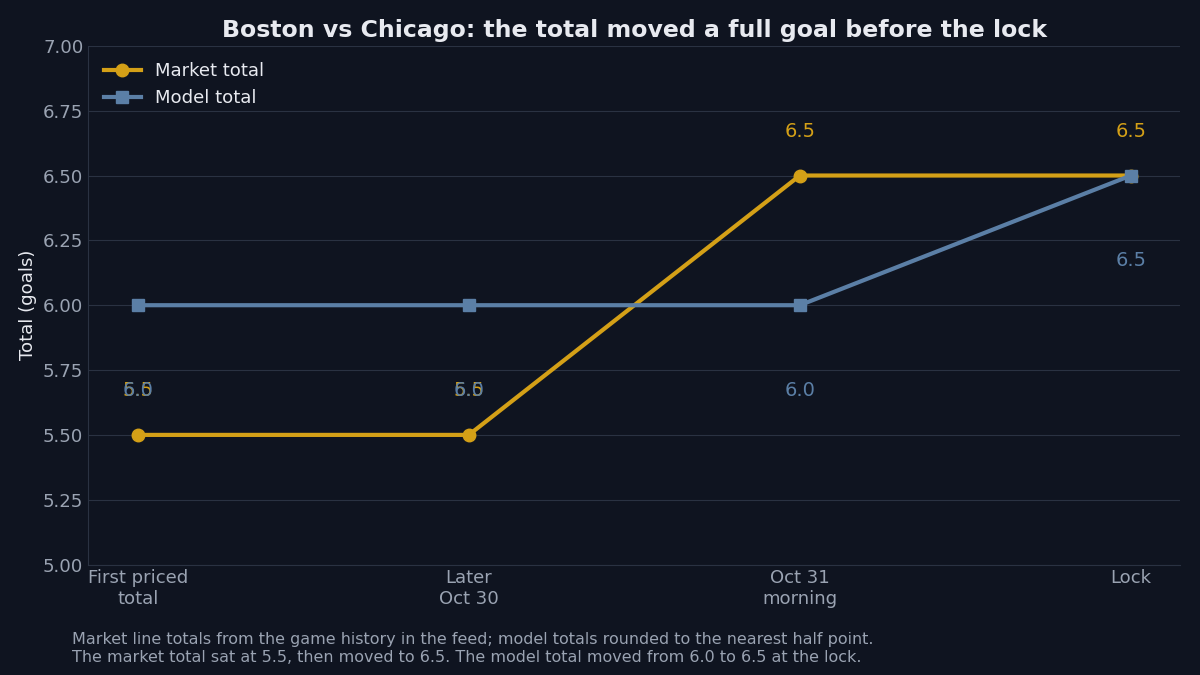
The moneyline moved in the same direction. Boston opened in the history at -218, moved to -225, and locked at -238, while the model chance for a Boston win moved from about 68.5% to about 72%. The update that showed Arvid Soderblom as the away goalie, where Spencer Knight had been shown before, also showed the higher model chance. The market and the model moved together. That still proves nothing about the result.
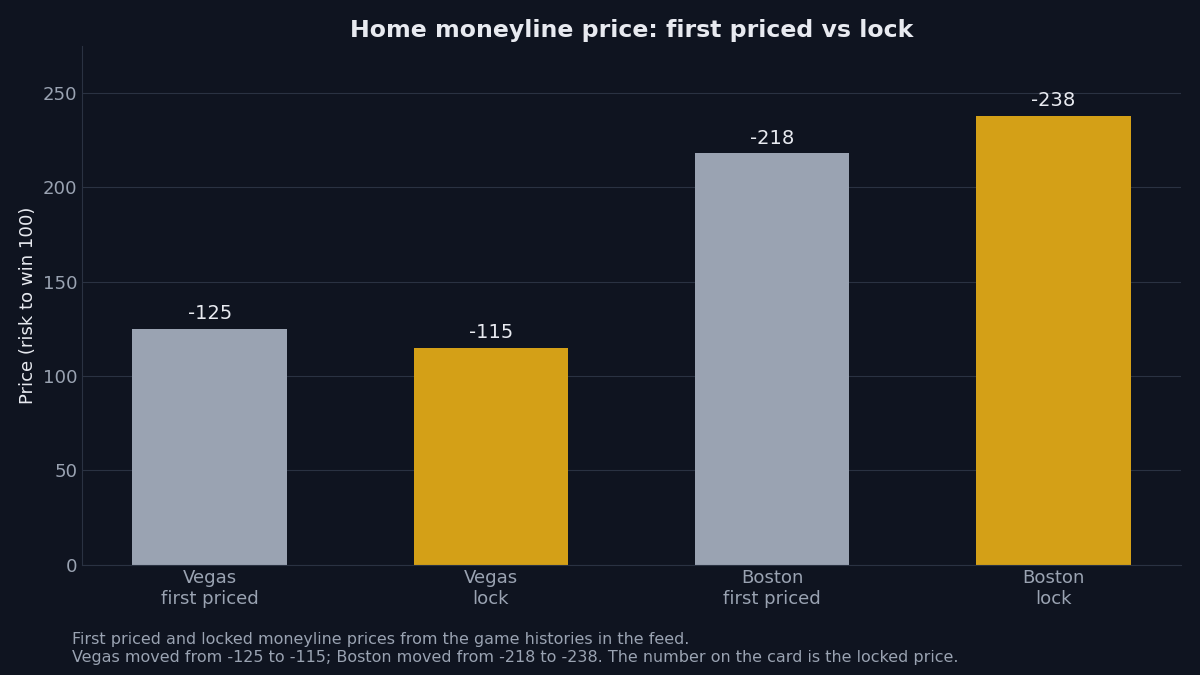
Vegas against New Jersey shows the smaller kind of move: the Vegas moneyline moved from -125 to -115 while the total stayed at 6.5. The price moved. The number did not.
What movement does not do
Movement does not change a locked pick, the model number after the lock, or the grading, which runs at the locked line. When the market moves toward the model number, the gap shrinks, and a later reader sees a smaller gap than the locked pick saw. The locked gap is the one that counts, because it is the gap at the price the pick was graded at.
Movement also does not reveal who placed the money, or why. Read the news that is shown, read the size of the move, and leave the rest as unknown.
How to read the next move
Ask three questions. First, did the number move, the price move, or both? Second, did the model number move too? If it did, news changed the inputs. If it did not, the market moved on money or on information the model did not use. Third, when did the move happen relative to the lock? A move before the lock can change the card. A move after the lock changes nothing about the grading.
A large move deserves a look at the news around it. A move with no news behind it deserves the least attention of all.
Lines move because games are priced in public, in the open, as information arrives. Watch the move, find the cause, and judge the locked line on its own. The move is information. The result is separate.
21+. If gambling stops being fun, call or text 1-800-GAMBLER.