How pick strength is decided: what slight, moderate, and strong mean on a card
Every lean on this site carries a label: slight, moderate, or strong. The label answers one question only: how far apart are the model's number and the market's number? A slight lean is the smallest disagreement shown. A moderate lean is a larger one. A strong lean is the largest. The label does not say how likely the pick is to win, and it does not change how the pick is graded. Every pick is graded at one unit, at the line it locked at, whatever its label reads.
One game, three labels
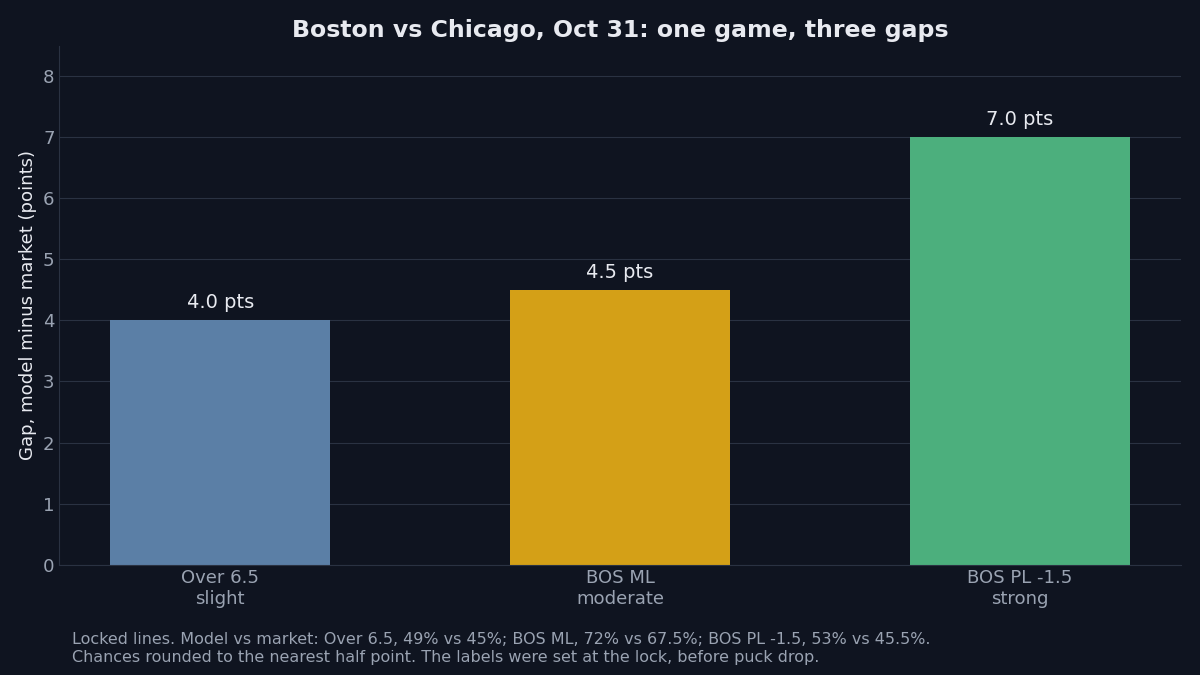
Boston against Chicago on October 31 shows the whole system in one game. All three leans were locked before puck drop, and each carries a different label because each gap is a different size.
The moneyline reads moderate. The model put Boston at about 72%, against a market chance of about 67.5%, a gap of about 4.5 points. The total reads slight. The model put the Over 6.5 at about 49%, against a market chance of about 45%, a gap of about 4 points. The puck line reads strong. The model put Boston -1.5 at about 53%, against a market chance of about 45.5%, a gap of about 7 points. The label follows the gap, nothing else.
The gap is measured in each market's own units
In hockey and in football moneylines and puck lines, the gap is measured in probability points: the model's chance minus the market's chance. In football spreads and totals, the gap is measured in points on the scoreboard: the model's margin or total minus the market line. In college football, the gap is measured the same way, in points between the model's margin and the market line.
The bands are set separately for each market, because a point means something different in each market. In football, a total gap of about 7.5 points carried the strong label in the Green Bay at Tampa Bay game. In college football, a gap of about 6.5 points carried the strong label, a gap of about 4 points carried the moderate label, and a gap of about 1.5 points carried the slight label.
The price does not set the label. Boston's moneyline sat at -238 and reads moderate, while Boston's puck line sat at +110 and reads strong. The New York Giants moneyline at +400 in Week 7 read strong, and an Under 6.5 at -135 in hockey read strong. The price says what a win pays at the locked line. Strength says how far apart the two numbers are.
A gap below the floor gets no label at all
Not every disagreement becomes a lean. In the Seattle at Calgary game on October 30, the Seattle moneyline read slight, with a gap of about 3 points, and the Under 6.5 read strong, with a gap of about 7.5 points. The puck line in that game, Seattle -1.5 at +205, had a gap of about 3 points, with the model at about 34.5% against a market chance of about 31.5%, and it carried no label at all. It was not shown as a lean, and it was not graded. The floor keeps the smallest disagreements off the card. Slight is the smallest label that appears, and a gap under the floor appears as nothing.
Strong still loses
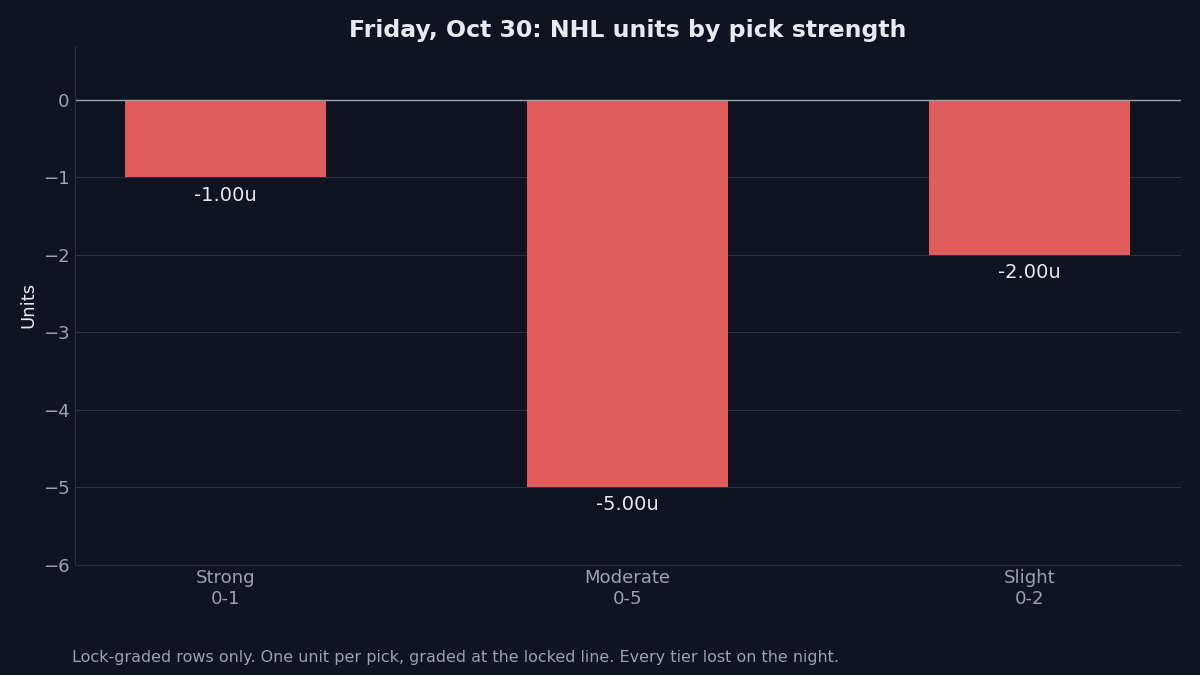
Strength ranks the size of a gap, not certainty. On October 30, the hockey card lost in every tier: the strong leans went 0-1 for -1.00u, the moderate leans went 0-5 for -5.00u, and the slight leans went 0-2 for -2.00u, for 0-8 and -8.00u in all. The strongest lean of that night, the Under 6.5 in Calgary, lost as Calgary scored 6 goals on its own and the game finished at 8 goals, 1.5 goals over the line.
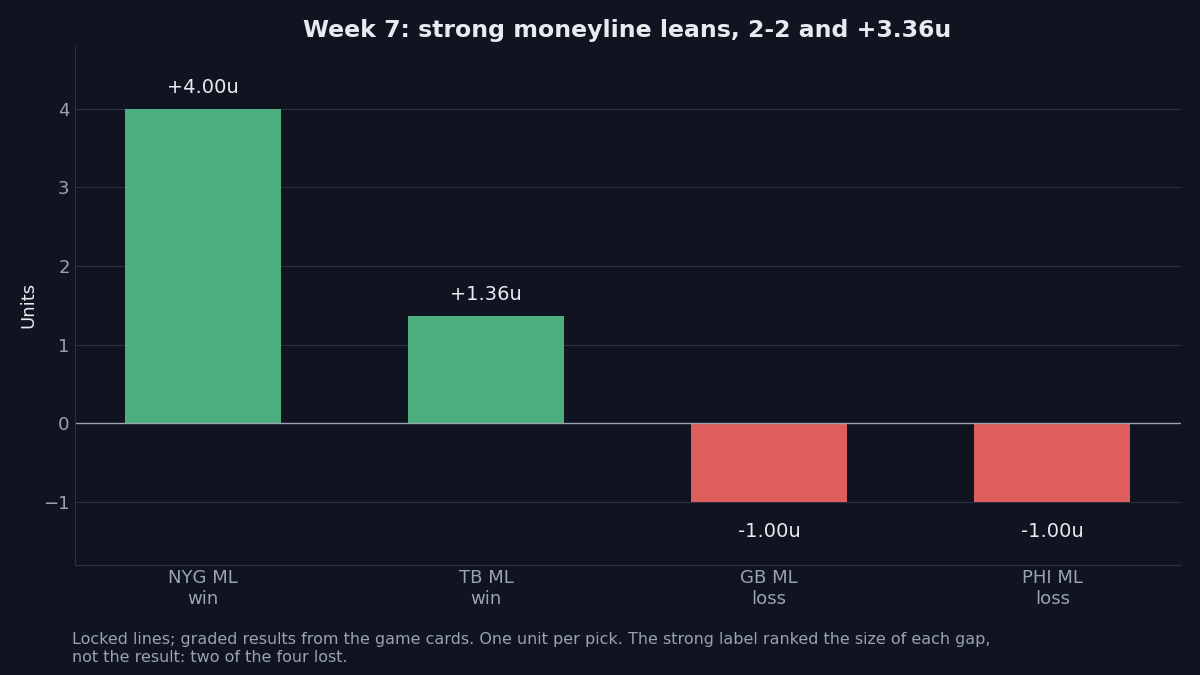
Week 7 in football shows the other side of the same point. Four moneyline leans carried the strong label at the lock. The Giants moneyline won for +4.00u, and the Tampa Bay moneyline won for +1.36u. The Green Bay moneyline lost for -1.00u, and the Philadelphia moneyline lost for -1.00u. Two wins, two losses, and +3.36u in all. The strong label described how far each model number sat from its market number. It did not describe the results, and half of the four still lost.
How to read the label on a card
Read the gap first. The label is a short way of saying how large the disagreement is, in that market's own units. Read the market second. A strong total and a strong moneyline are large gaps in different units, so compare labels only inside the same market. Read the price third, on its own. The price tells you the return at the locked line, and it plays no part in setting the label. Then read the trends around the pick as context: trends describe how similar spots have played out before, and they do not change the label or the locked line.
A slight label is worth the same reading as a strong label, with one difference: the disagreement is smaller. That is all the label claims. When the gap is large, the label says strong. When the gap is small but still above the floor, the label says slight. The grading still runs at one unit, at the locked line, for every label alike.
21+. If gambling stops being fun, call or text 1-800-GAMBLER.