How to read a spread, a total, a moneyline, and a puck line
Four ways to read one game
One game can appear on this site in four markets at once, and each market asks a different question. A spread asks how much a team wins by. A total asks how many points or goals the two teams combine for. A moneyline asks only who wins. A puck line asks the hockey version of the spread question, with a fixed margin of a goal and a half. A team can win the game and still lose on the spread, because the markets are answering different questions.
Examples below use locked lines for Detroit against Chicago on October 29 and Chicago against New England on October 23. Lines are shown to the nearest half point; percentages are rounded to whole numbers.
The spread: a head start in points
A spread gives the underdog a head start and asks the favorite to win by more than the number shown. Chicago was listed at minus 1.5 against New England, so Chicago needed to win by 2 points or more. New England, at plus 1.5, needed to lose by 1 point or fewer, or to win outright. A margin of exactly 1.5 points cannot happen in football, so a half-point spread always has a winner and a loser.
A whole-number spread can push: minus 3, winning by exactly 3, neither wins nor loses, and the unit is returned. The half point, often called the hook, removes the push. A line of 3.5 and a line of 3 are not the same line.
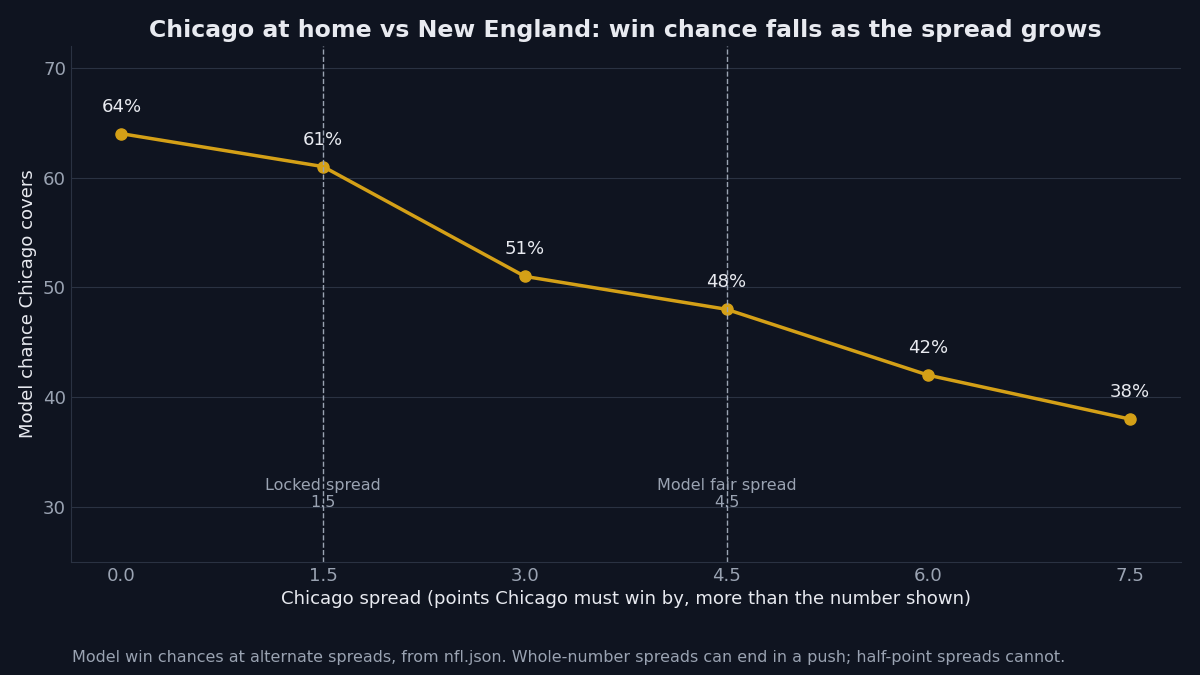
The model reads a spread as a fair margin. For Chicago against New England, the model's fair spread was 4.5 points, while the locked market spread was 1.5. The model's chance of Chicago covering 1.5 was 54%, against a market chance of 50%. As the spread grows, the chance of covering falls: 64% at a spread of 0, 51% at 3, 48% at 4.5, and 38% at 7.5. A spread is a price on a margin, and moving the margin moves the price.
The total: points or goals, not a winner
A total asks nothing about who wins. It asks how much scoring the two teams produce together. Chicago against New England carried a total of 50.5. Over 50.5 needed 51 points or more from the two teams combined. Under 50.5 needed 50 points or fewer. The half point does the same job here as on a spread: 50.5 cannot land exactly, so there is no push.
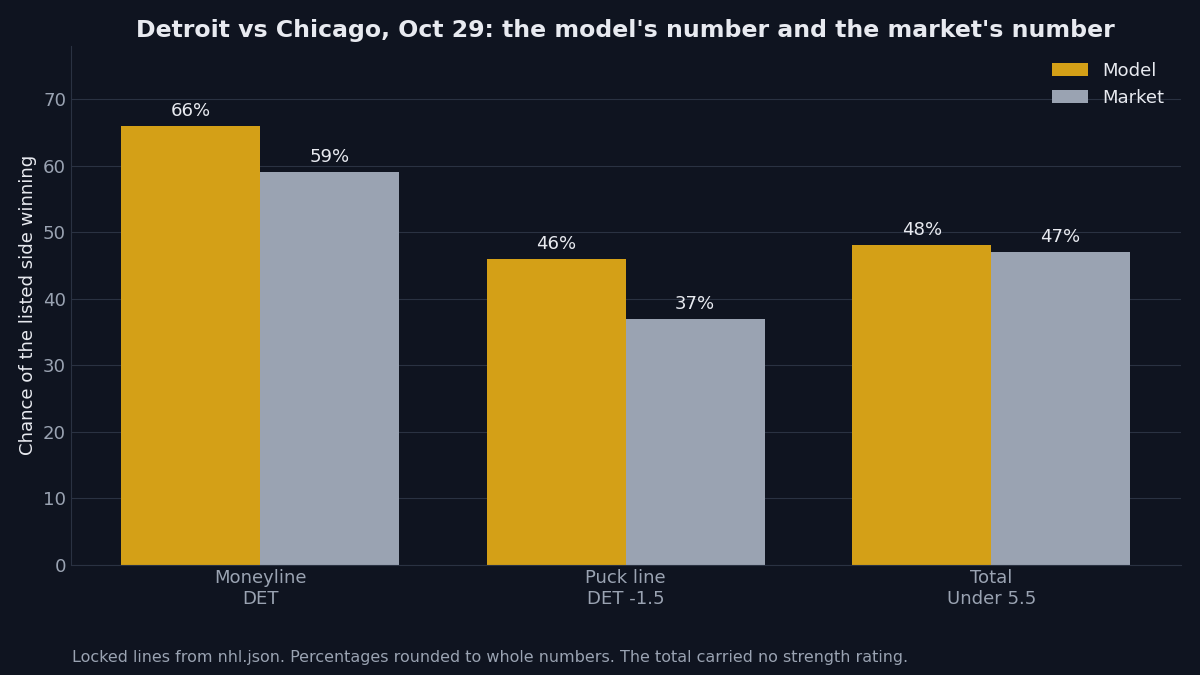
The model reads a total as an expected score. For that game, the model's fair total was 45 points, against a market total of 50.5, a gap of 5.5 points. In hockey, Detroit against Chicago carried a total of 5.5 goals, and the model expected about 6 goals. The final score was 4-1, five goals in all, so the Under 5.5 side finished ahead. The total is the market where the final score matters most and the winner matters least.
The moneyline: who wins, at a price
A moneyline strips the margin away entirely. Detroit was listed at minus 162 against Chicago, and Chicago was listed at plus 136. The minus sign marks the favorite: risk 162 to win 100. The plus sign marks the underdog: risk 100 to win 136. There is no margin to cover and no total to clear.
Prices translate into chances. Minus 162 implies a chance of about 62%. Plus 136 implies a chance of about 42%. Those two chances add to more than 100% because the difference is the bookmaker's margin, often called the juice. For Detroit, the model put the win chance at 66%, against a market chance of 59%.
The puck line: hockey's spread, almost always a goal and a half
Hockey has no 3.5 or 7.5 spreads. The puck line is almost always set at 1.5 goals. Detroit was listed at minus 1.5 against Chicago, at a price of plus 160, so Detroit needed to win by 2 goals or more. Chicago, at plus 1.5, needed to lose by 1 goal or fewer, or to win outright. Detroit won 4-1, by 3 goals, so the minus 1.5 side finished ahead. The model's chance for Detroit minus 1.5 was 46%, against a market chance of 37%. A puck line favorite wins the game far more often than it covers the puck line, because so many hockey games finish with a one-goal margin.
The underdog side shows the separate-markets idea most clearly. Columbus lost 3-2 in Carolina on October 29, so the Columbus moneyline did not win. But Columbus at plus 1.5 on the puck line won, because a one-goal loss still sits inside a goal and a half. The same game, the same final score, two different results in two different markets. Reading the puck line means reading the margin, not the winner.
How the four lines sit together
The moneyline asks who wins. The spread and the puck line ask by how much. The total asks how much scoring happens along the way. The model's number and the market's number sit side by side in each market, and the gap between them is what the model is reporting. A large gap in one market does not carry over to the others.
Three habits make a card easier to read. First, read the line to the nearest half point, and note whether a push is possible. Second, compare the model's number with the market's number in the same market, not across markets. Third, remember that picks lock two hours before the start and are graded at the line they locked at. Trends add context around a pick. They do not replace the line, the price, or the gap.
21+. If gambling stops being fun, call or text 1-800-GAMBLER.