Weather and totals in football: what wind, rain, snow, and cold actually do to a total
A total is a weather forecast wearing a different hat. When the wind picks up in Green Bay or the rain starts falling in Seattle, the number on the board moves, and it moves for a reason: points in football come mostly through the air, and no coach controls the air. This site's model reads the forecast on every NFL game card. Here is what it reads, and what the 2026 season shows so far.
What the model reads on every card
Five weather entries sit on every NFL game card in the feed: whether the game is indoors, wind above 10 mph, precipitation, snow, and cold below 40 degrees. They sit there on every card, even when the weather is calm. Wind is the one with a line drawn under it: 10 mph. Below that line, the wind entry reads as nothing. Above it, it starts pulling the total down, a little more with each extra mph. Rain and snow are measured in inches, cold in degrees below 40. None of them is a pick on its own. They are small adjustments to a number that starts with league scoring and the two offenses and defenses.
A worked example: Detroit at Miami
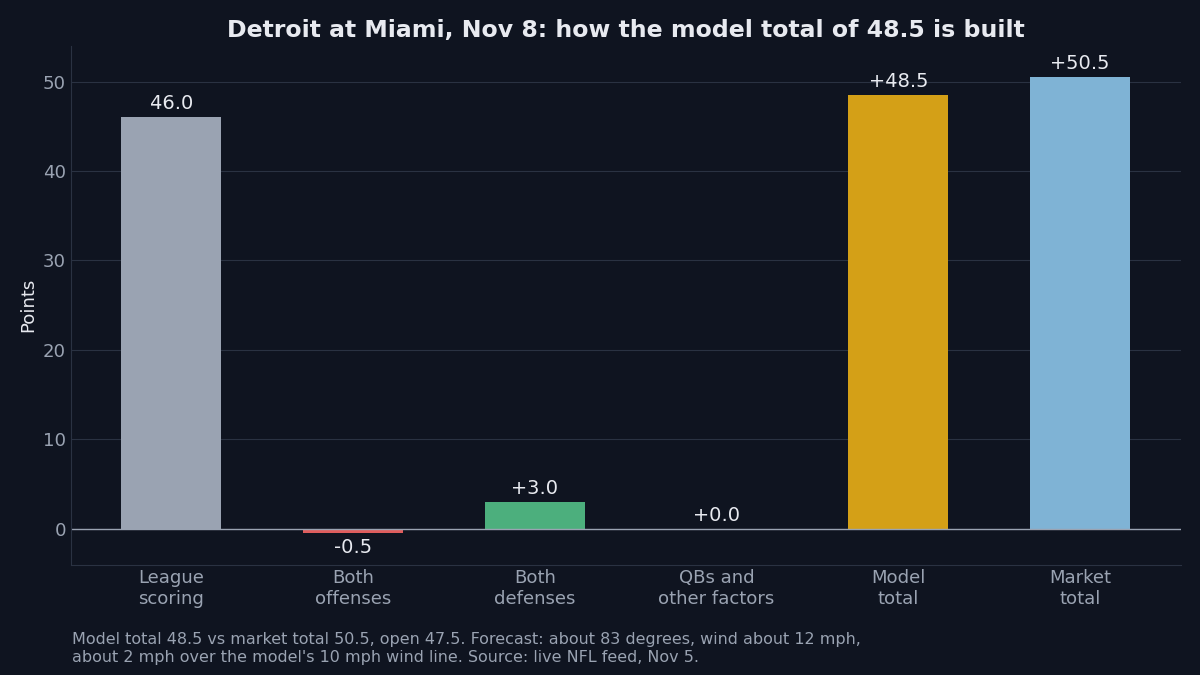
Detroit visits Miami on Sunday, Nov 8, outdoors at Hard Rock Stadium. The forecast in the feed reads about 83 degrees, wind about 12 mph, no rain, no snow. That wind sits about 2 mph over the model's 10 mph line, so the wind entry points down on the total. The model total is 48.5. The market total is 50.5, where it has sat since Nov 3 after opening at 47.5. The gap leaves a slight lean to the Under at 50.5. The build is plain to read: league scoring 46.0, both offenses a half point lower, both defenses 3.0 higher, quarterbacks and other factors flat. Add them up and the total lands at 48.5, a full 2 points below the market number. The wind is one line in that build. The defenses are doing more of the work.
What the season shows so far
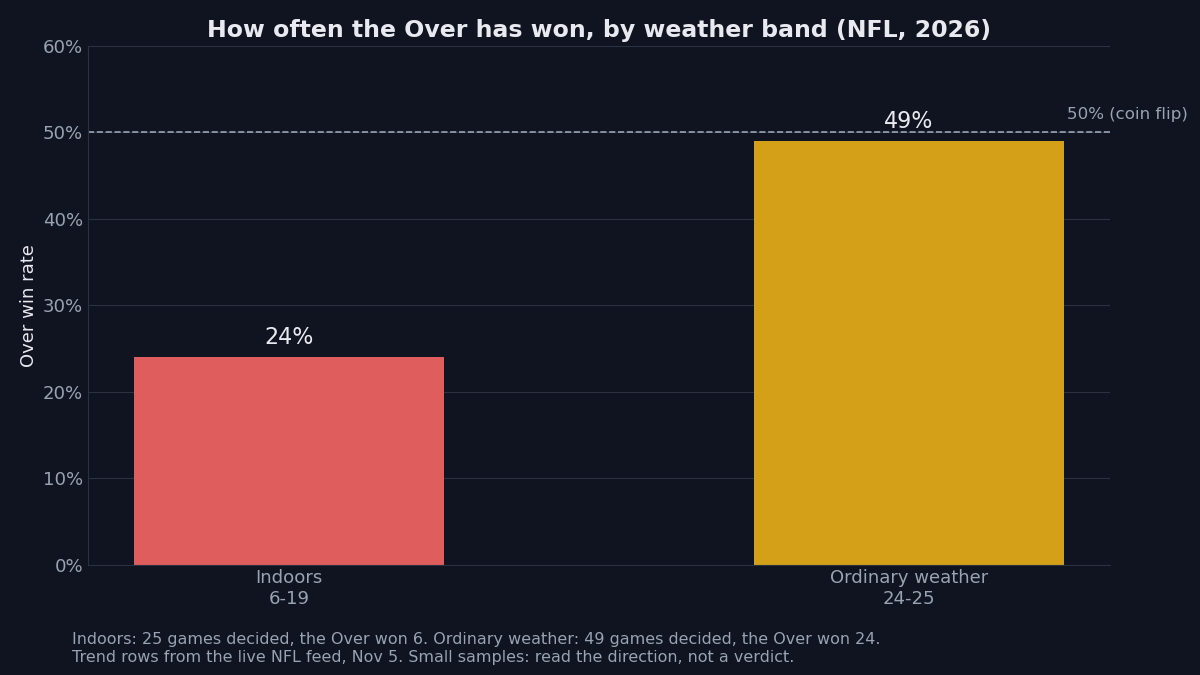
Trend rows in the live feed split every graded total by its weather band. Indoors, the Over has won 6 of 25 games, or 24%. In ordinary weather, the Over has won 24 of 49, or 49%, about a coin flip. The indoor number is the one to handle with care: 25 games is a small sample. What the split really says is simpler. Outdoors, in ordinary weather, totals have landed about where the market priced them. Indoors, with no wind and no rain in the way, the market total has been a little high so far, and the Under has won 19 of 25. That is a direction to watch, not a rule to follow. One windy Sunday can move it a long way.
When the wind stays under the line
Wind below 10 mph still shows up in a game. Carolina visited Green Bay on Oct 29 with the wind at about 7 mph and gusts near 20. The model total was 46.0 against a market total of 47.5, and the slight lean to the Under won at +0.80u as the game finished Carolina 19, Green Bay 27, or 46 points. The wind never crossed the model's line, and the game still went under, which is the point: weather is one input among many, and a single game never proves a rule. Denver at Carolina on Nov 9 shows the other side of it. The market total there has swung between 43.5 and 44.5 in two days, while the model total has held at 46.5. The market number moves as the forecast and the money firm up. The model number only moves when its inputs move. Both numbers freeze at the lock, and the grade uses the locked line, whatever the sky does after that.
College: teams move totals more than weather
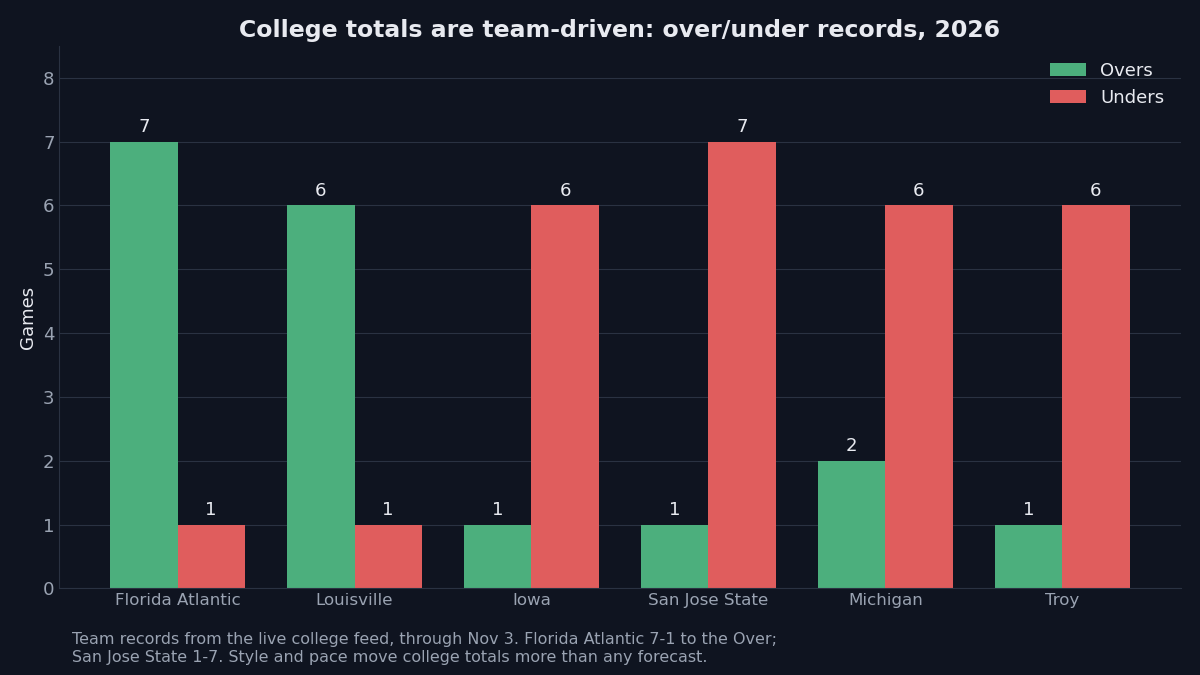
In college, the forecast matters less than the teams. Through Nov 3, Florida Atlantic has gone over in 7 of 8 games and Louisville in 6 of 7, while San Jose State has gone under in 7 of 8 and Iowa in 6 of 7. Michigan sits at 2-6 to the Over and Troy at 1-6. Those splits are about pace and style: a fast team that throws deep will push a total up in any weather, and a slow team that runs will hold it down. Weather still counts in college, and the same wind line applies, but when a team has gone one way in 7 of 8 games, the team is the story.
How to read a total when the forecast changes
Three checks, in order. First, the roof: a dome removes wind, rain, and snow from the game entirely, and the indoor split above is the reason to look. Second, the wind line: 10 mph is where the model starts counting, so read the gust number next to the steady wind, because a calm wind with strong gusts is not a calm day. Third, the move: if the total has moved with the forecast, the market has already priced the weather in, and the gap between the model number and the market number is what is left. A total that has not moved while the forecast has turned is the one worth a second look. None of this turns weather into a system. It turns a total into something readable: a number built from scoring, offenses, defenses, and a sky that sometimes gets a vote.
Weather will keep moving totals all season, and the model will keep reading the same five entries on every card. Read the forecast the way the model does: as an input, not an answer.
21+. If gambling stops being fun, call or text 1-800-GAMBLER.