What a unit is, and why every result here is counted in units
Every result on this site is written in units: +3.71u, -8.00u, +0.56u. A unit is the standard amount risked on each graded pick, and every pick on the card is graded at one unit. That single rule lets a hockey moneyline, a football total, and a college spread sit in the same record and be added together.
What one unit means
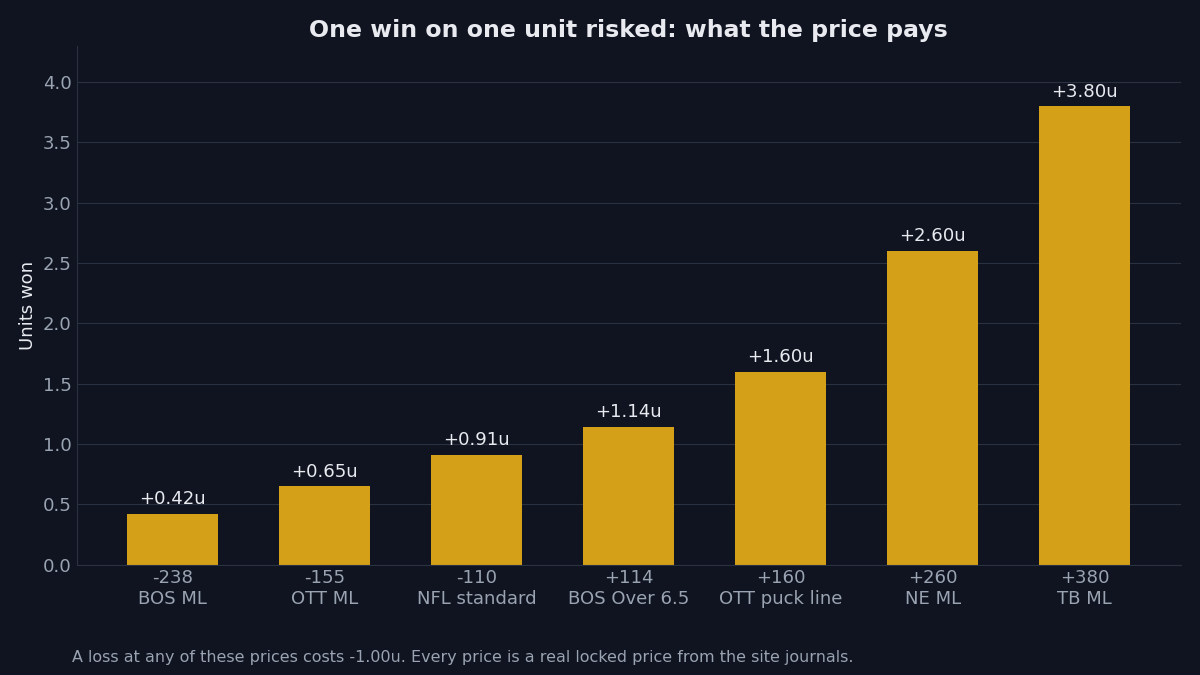
One unit is the amount risked. The price then decides what a win returns. A minus price shows how much must be risked to win 100 in the same currency: at -110, a win returns +0.91u on one unit risked, and a loss costs -1.00u. At -238, the price Boston carried on October 31, a win returns +0.42u. A plus price shows what one unit risked wins: at +160, the price on the Ottawa puck line that same night, a win returns +1.60u, and a loss still costs -1.00u. The loss is always -1.00u. The win moves with the price.
That is why the journal records units rather than wins alone. A win at +380, the price on Tampa Bay on October 8 in the football journal, returned +3.80u. A win at -110 returns +0.91u. Both count as one win. They are not worth the same amount, and the unit record is the record that shows the difference.
Why a split record can finish behind
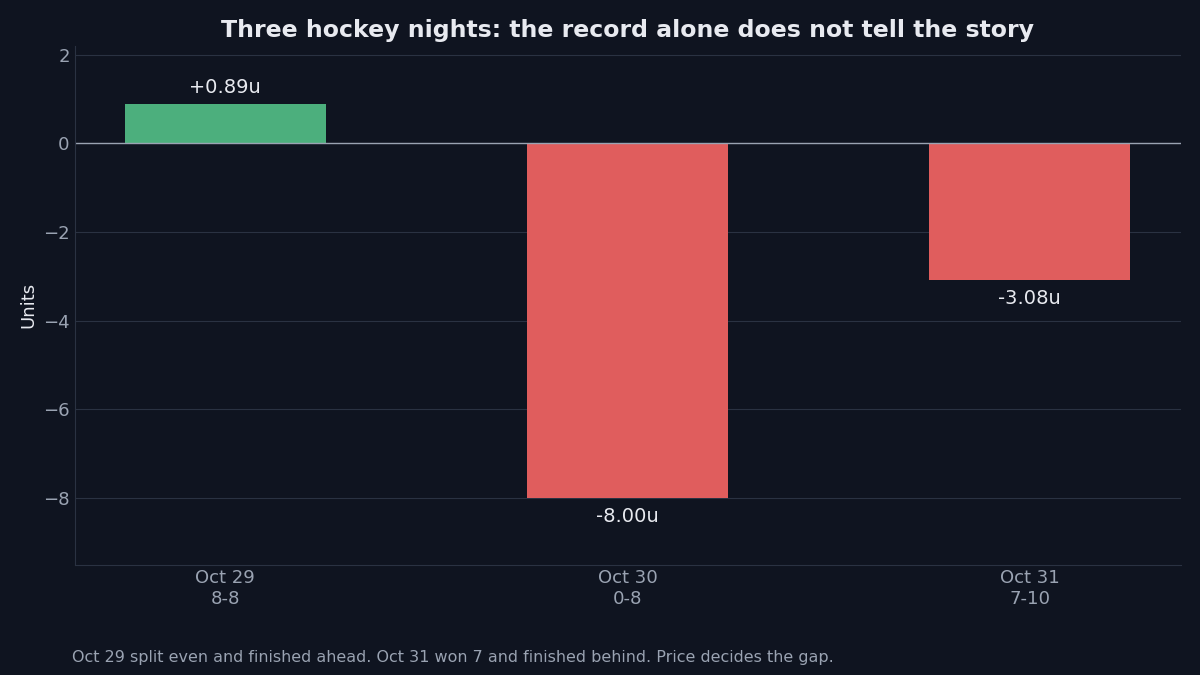
October 29 in hockey split 8-8 and finished at +0.89u. October 31 won 7 of 17 and finished at -3.08u. October 30 lost all 8 and finished at -8.00u. The first night is the clearest lesson: the record alone hides the prices, and the prices decide the total.
College football on October 31 makes the same point from the other side. The leans split 37-37-2 and finished at -3.36u at -110. The 37 wins returned +33.64u, because each win at -110 pays +0.91u, and the 37 losses cost -37.00u. A record of exactly half wins and half losses still finishes behind when every win pays less than every loss costs. That gap is the price of the market itself. The unit total carries that fact. The win count does not.
A card can also finish ahead while winning fewer games than it loses, when its wins sit at plus prices and its losses sit at short prices. One win at +380 returns +3.80u, more than three wins at -110, which return +2.73u combined. The win count and the unit total answer different questions, and only the unit total answers whether the card finished ahead.
How one game adds up
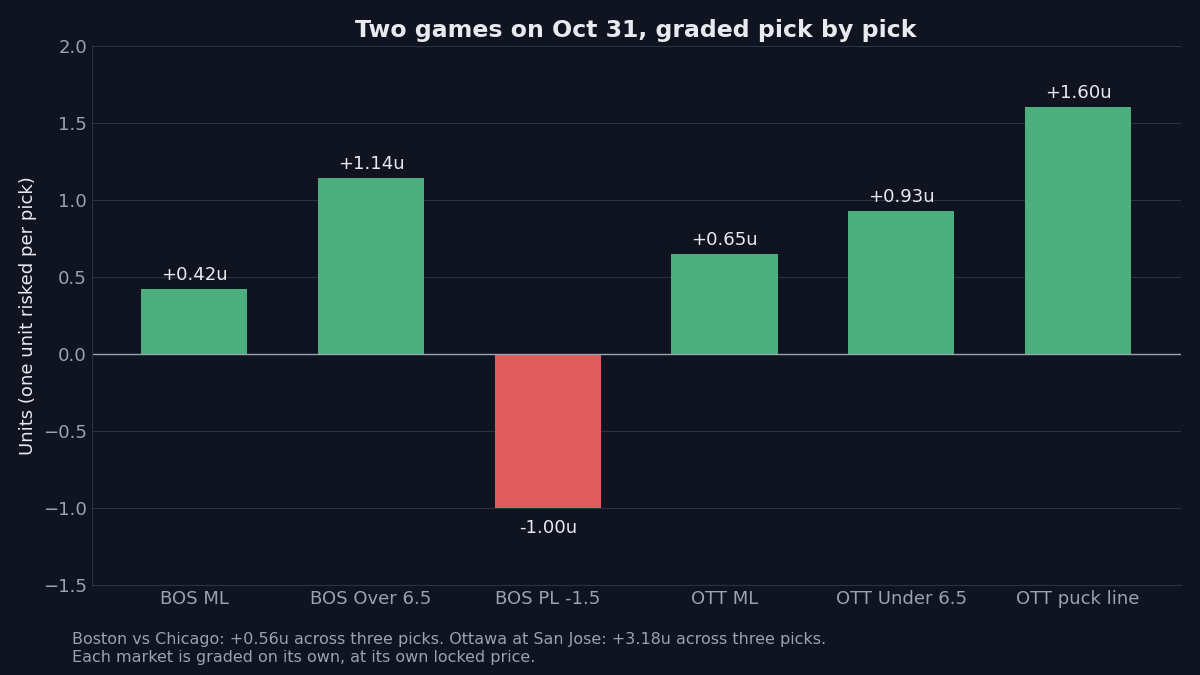
Boston against Chicago on October 31 carried three graded picks. The moneyline won for +0.42u. The Over 6.5 won for +1.14u. The puck line, Boston -1.5, lost for -1.00u, because Boston won by one goal in overtime. Added together, the game finished at +0.56u. No single market decides a game on this site. Each market is graded on its own, at the price it locked at, and the game total is the sum.
Ottawa at San Jose the same night shows the other end. All three picks won: the moneyline for +0.65u, the Under 6.5 for +0.93u, and the puck line for +1.60u, for +3.18u in one game. A push, where a pick lands exactly on the number, is neither a win nor a loss, and adds nothing to either side. The unit record counts only what the locked prices returned.
Reading a season record in units
Through October 31, the hockey card stood at 171-169 and +3.71u, and the football card stood at 64-63-1 and +5.78u. Both records sit near half wins and half losses, and both finish ahead in units, because the mix of prices across a season matters as much as the count of wins. A season record is read the same way as a single night. The difference is the size of the sample. One night holds 17 picks. A season holds hundreds, and a small edge, or a small shortfall, shows up more clearly across hundreds than across one night.
A unit is a measuring stick, not a suggested amount. The site grades every pick at one unit so that records compare cleanly across prices, markets, and sports. The record does not say what any reader should risk. It says what one unit risked on each pick returned, at the locked price, over the games graded so far.
What to check before the next card
Four checks carry the whole idea. First, read the record and the units together, never one without the other. Second, look at the prices behind the wins: short prices need more wins to finish ahead. Third, ask how many picks sit behind a total: a single night can swing on one overtime goal, and a season total moves more slowly. Fourth, remember that each pick is graded at one unit, so a strong label does not mean a larger amount was risked. Strength describes the size of the gap between the model and the market, not the size of the amount risked.
21+. If gambling stops being fun, call or text 1-800-GAMBLER.