What counts as a system: a rule, a test, and a bar it has to clear
The word system gets used a lot in sports betting, usually for something that is not a system at all. A hot run is not a system. A hunch with a name is not a system. A system is a rule, written down before the games, applied the same way every time, and graded against a bar set in advance. If two people following the rule land on different picks, it was never a rule. This site's journal lets us test three simple rules on the same season and see how different the answers come out.
A system is a rule, written down first
The first part is the writing. A rule has to be specific enough to repeat: who it applies to, which market, and what counts as a yes. "Every NHL puck line the model labels" is a rule. "Hockey when the matchup looks good" is not, because two readers will read it two ways and the record will mean nothing. The labels on this site are the rulebook in miniature: slight, moderate, and strong, each set by the size of the gap between the model number and the market number, with a floor below which a game carries no label at all.
The second part is the order: the rule comes before the results it grades. A rule written after the results are known is a story about the past, dressed up as a plan for the future. The honest version is boring: write it, freeze it, then grade what comes next and let the numbers speak.
Three rules, one season, three answers
Here are three rules from the same model and the same season, graded on the lock-graded rows in the site journals through November 8. Rule one: every labeled NHL puck line, 101 graded picks, 51-50, for +12.5u. Rule two: every labeled NFL spread, 56 graded picks, 33-23, for +6.5u. Rule three: every labeled NFL moneyline, 58 graded picks, 21-36-1, for -5.5u. Same model, same season, three rules, three answers.
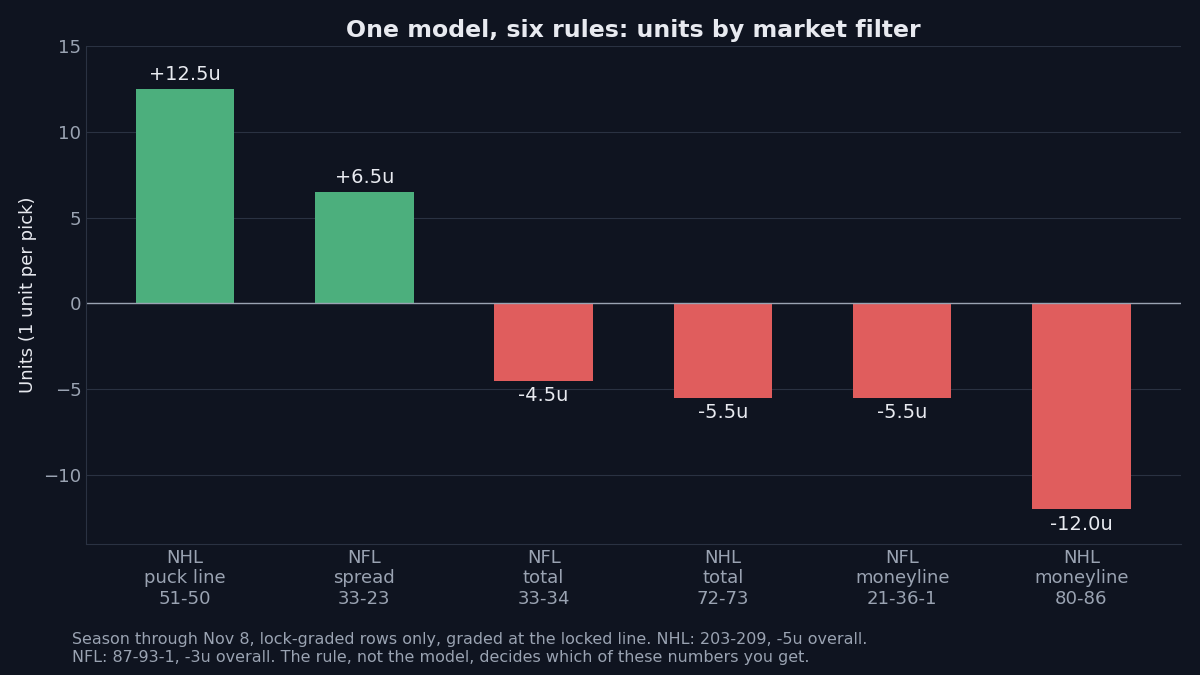
The rest of the card: hockey moneylines 80-86 for -12u, hockey totals 72-73 for -5.5u, football totals 33-34 for -4.5u. All together, the whole card reads 203-209 for -5u in hockey and 87-93-1 for -3u in football. The whole card is itself a rule, "every labeled pick," and the market filter changes the answer completely. A record without a rule attached is a number without a meaning.
Win rate is not profit
The three rules also show why a win rate on its own tells you very little. The puck line rule won 50.5% of its games and made +12.5u. The spread rule won 59% and made +6.5u. The moneyline rule won 36% and lost -5.5u. The puck line wins about half its games and still clears a profit, because puck lines often pay plus money: a win at +180 covers nearly two losses at the same price. The moneyline rule lost because 36% wins at mostly short prices cannot cover the losses behind them.
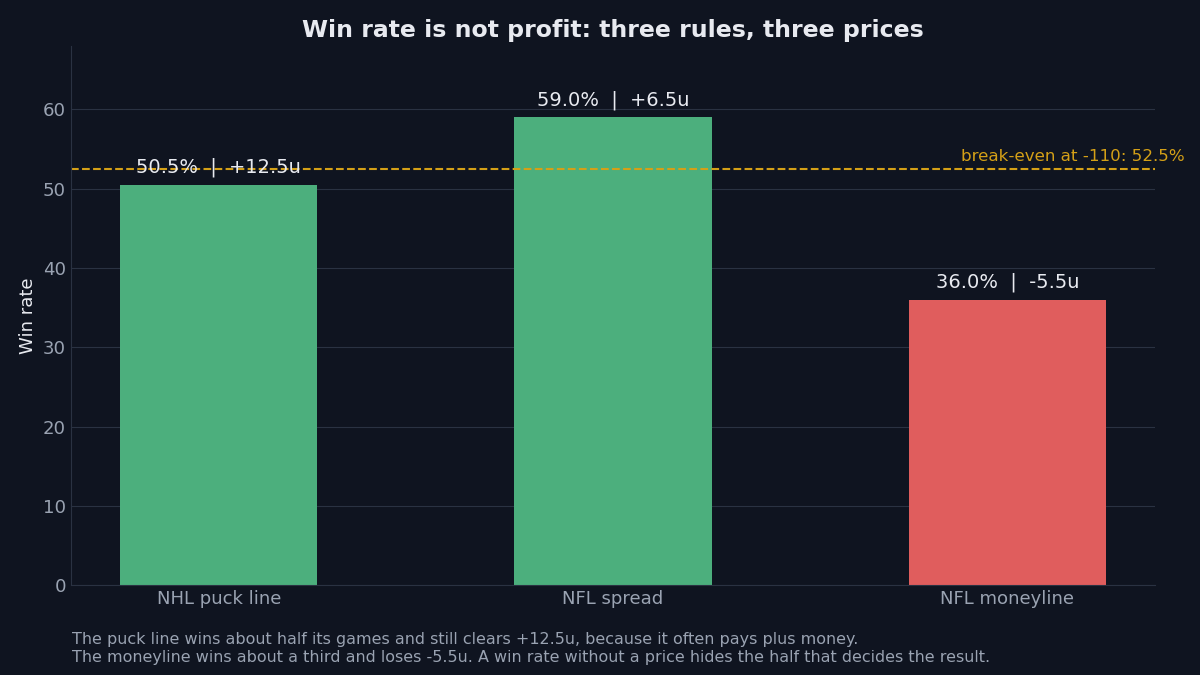
The price sets the bar, and the bar is exact. A pick at -110 has to win about 52.5% of the time to break even. A pick at +180 only has to win about 36% of the time. The puck line rule clears its bar on price, not on win rate. The moneyline rule fails its bar on both. When you read a system claim, the first question is not how often it wins. It is what price it pays, and what win rate that price needs.
The bar: enough games, and a test run forward
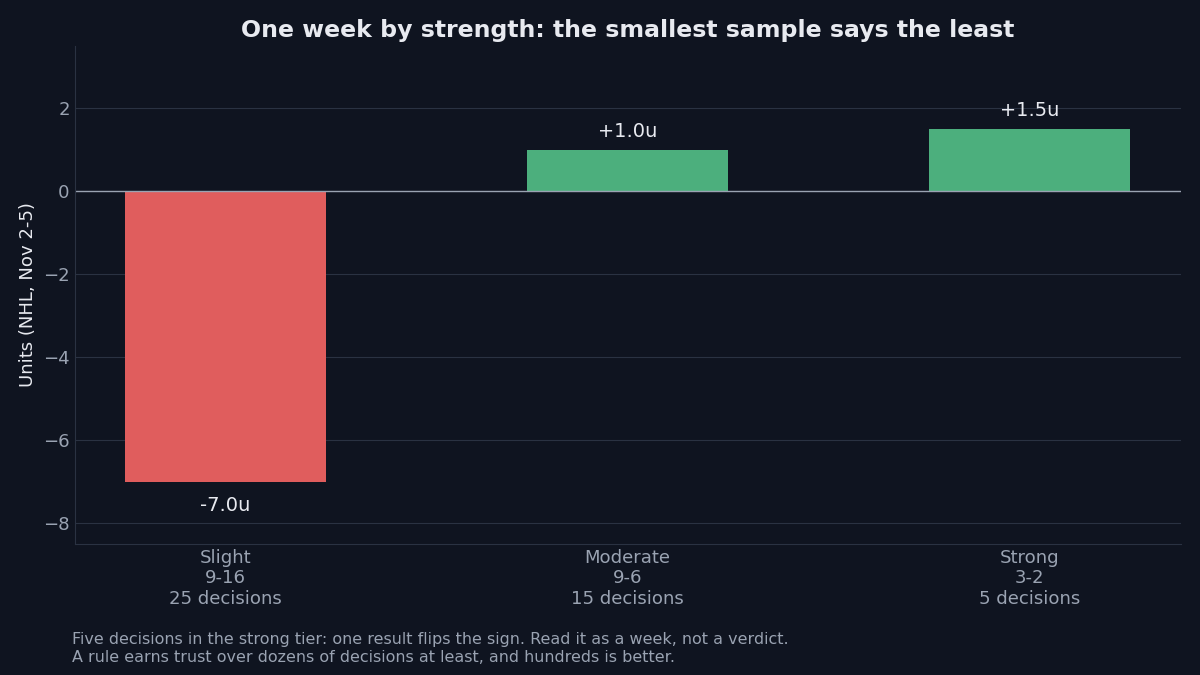
Two more parts decide whether a rule earns trust, and both are about patience. The first is sample size. Five decisions say almost nothing. Look at one week of hockey by strength, November 2 to 5: slight went 9-16 for -7u on 25 decisions, moderate went 9-6 for +1u on 15, and strong went 3-2 for +1.5u on 5. The strong tier's week is five games, and one result flips its sign. Read it as a week, not a verdict. A rule earns trust over dozens of decisions at least, and hundreds is better.
The second is the forward test. A rule graded only on the games it was built from has already seen the answers, so the test that counts runs after the rule is frozen. This site runs that test in public. The NBA model was tested on the 2024-25 season before any public pick was ever made, and it came in at 50.5% against the spread, below the 52.5% bar. So it stays in shadow testing, with no public picks, until a new test clears the bar. That is the bar doing its job, and the failed test stays published alongside the ones that passed.
How to read a system claim
Five questions. Is the rule written down, specific enough that two people following it land on the same picks? Was it written before the games it grades? How many decisions does it rest on, dozens at least? What price did it pay, and what win rate does that price need? Has it been run forward since the rule was frozen? If any answer is missing, it is a story, not a system.
The three rules above pass the checklist: written, frozen, and graded on 101, 56, and 58 decisions at locked lines, with prices and win rates shown. And two of the three are still losing. That is the honest part, and it is why the journal is published in full: most rules do not clear the bar, and the record shows it instead of hiding it. A system earns trust the slow way, one frozen rule and one graded season at a time.
21+. If gambling stops being fun, call or text 1-800-GAMBLER.