Why every pick locks before kickoff, and why the locked line is the only line that counts
The lock in one sentence
A lock is a freeze. At a set moment before a game starts, the model number, the market line, and the price are written down together, and the pick does not change. The market keeps moving and news keeps arriving, but the grade still uses the frozen line and the frozen price. That rule is what makes a record checkable. Without it, a reader could never tell whether a result was judged against the line named before the game or against a kinder line found after it.
What moves before the lock, with a real total
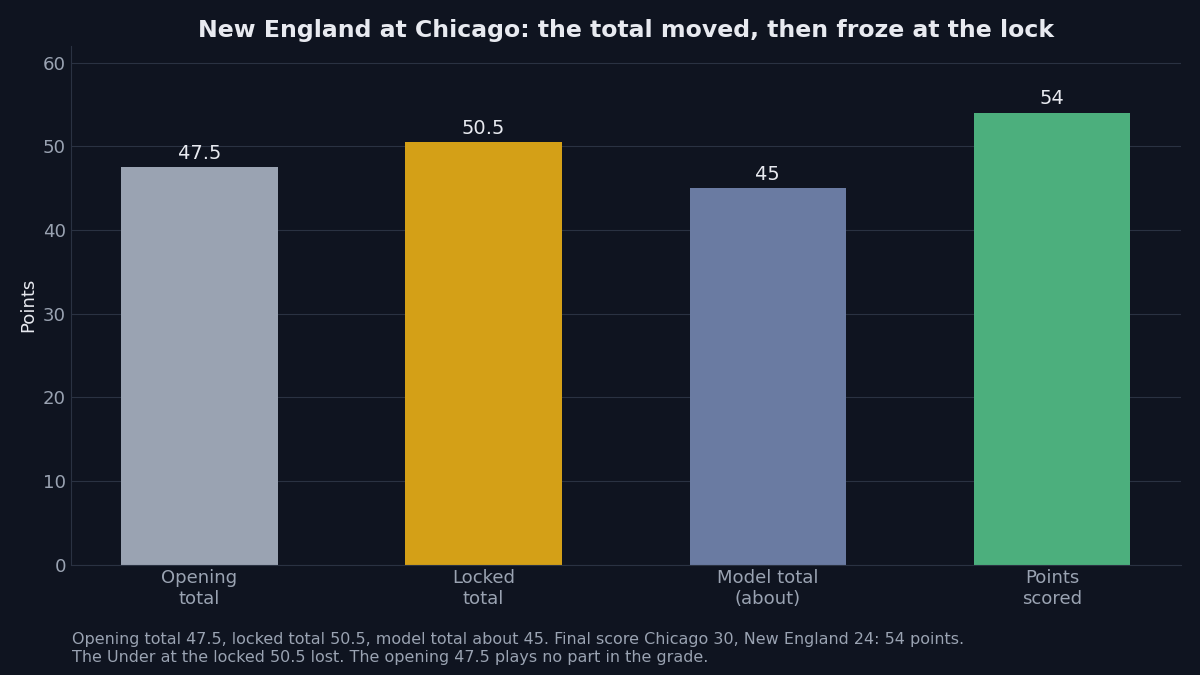
New England at Chicago in Week 7 shows the sequence. The game was first published with Chicago ahead by about three points and the line at Chicago -1.5. Over the next two days the model number rose to about five points, and the Chicago spread call moved from slight to moderate while the line stayed at Chicago -1.5. The total moved more plainly. The opening total was 47.5 and the locked total was 50.5, while the model total stayed at about 45 points, so the gap was about five points, with the model on the low side.
The lock came about three hours before kickoff. The final score was Chicago 30, New England 24: 54 points in total and a winning margin of six points for Chicago. Judged at the locked line, Chicago -1.5 won, Under 50.5 lost, and the Chicago moneyline won. The opening total of 47.5 plays no part in any of those grades, even though it was the first number readers saw days earlier. The line that counts is the line at the lock.
The same game shows why the close cannot replace the lock. The site review puts the closing spread at Chicago -3, a step and a half beyond the locked Chicago -1.5. Chicago covered either number, winning by six points, but grading at the close would credit the pick with a harder line than the one named before the game.
What the lock freezes: three things at once
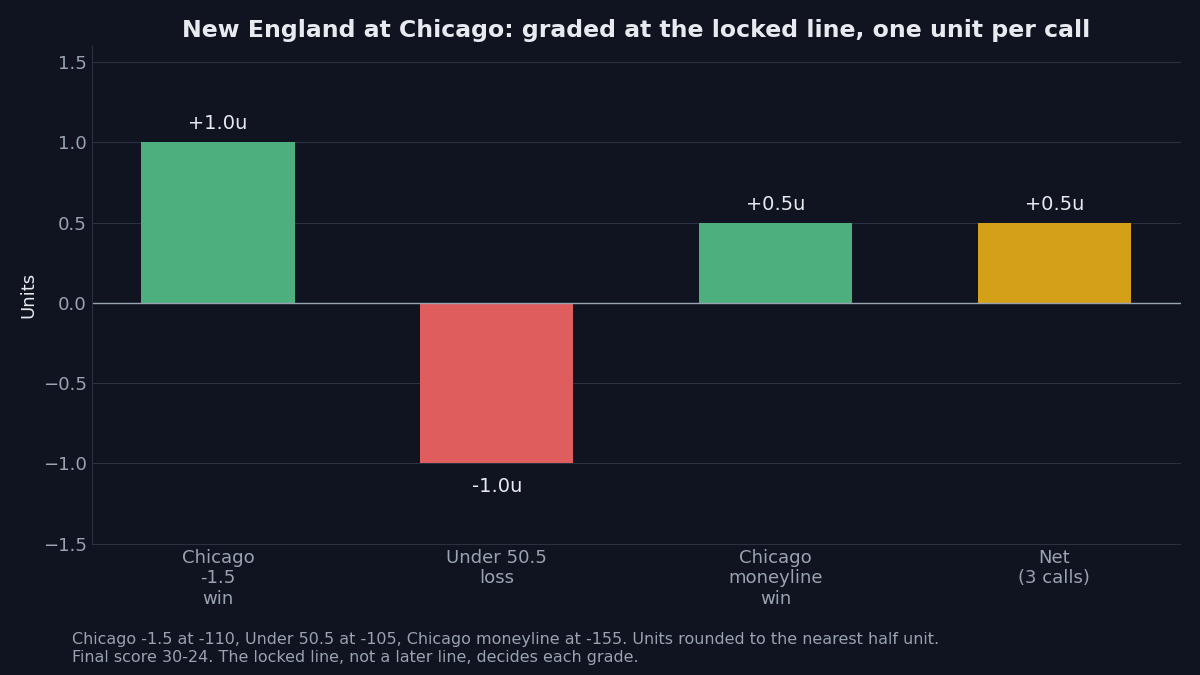
A lock freezes a line, a price, and a model number. The line decides the grade: Chicago -1.5 means Chicago must win by more than one point. The price decides the return in units: Chicago -1.5 was locked at -110, Under 50.5 at -105, and the Chicago moneyline at -155. The model number shows the size of the disagreement at that moment.
Rounded to the nearest half unit, the three Chicago calls add up to +0.5 units: Chicago -1.5 won for +1 unit, Under 50.5 lost for -1 unit, and the Chicago moneyline won for +0.5 units. Change any one frozen number and the sum changes, even though the game itself never changes.
A push follows the same rule. A line with a half point, as in 1.5 or 50.5, cannot be landed on exactly. A whole-number line can: if a total locks at 38 and exactly 38 points are scored, the call is a push, with no units either way. The lock decides which case applies.
A hockey lock, with a goalie change before it
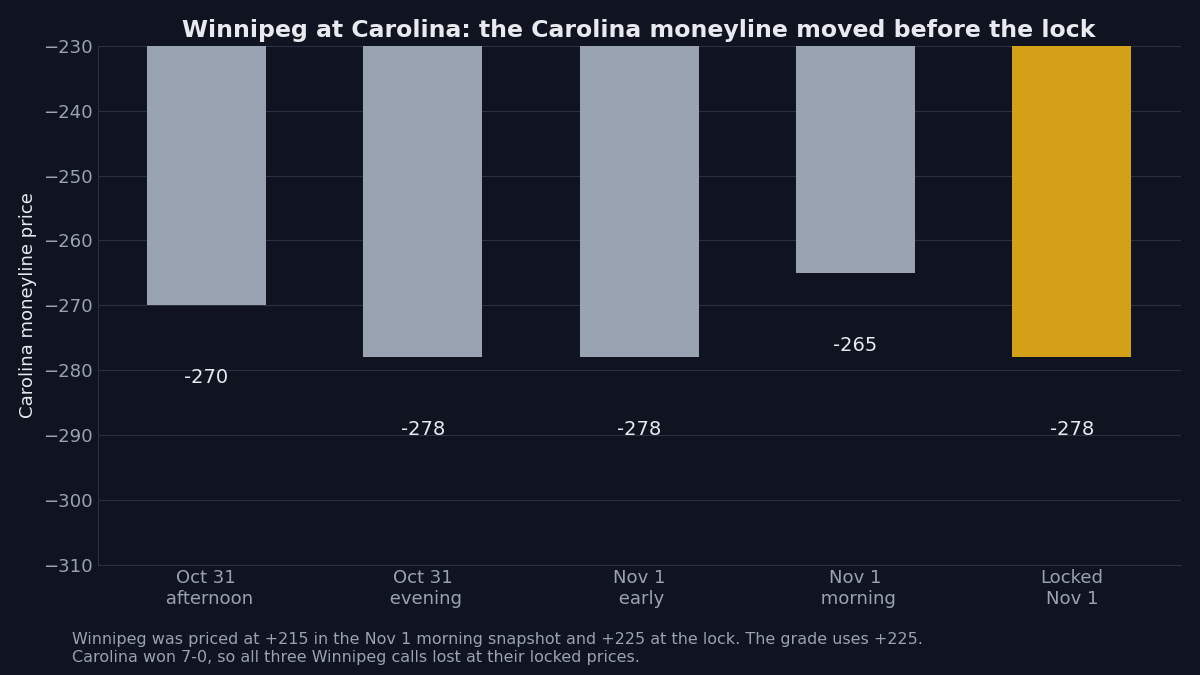
Winnipeg at Carolina on Nov 1 shows the lock in hockey, where a change of goalie can move a price in an hour. The Carolina moneyline was -270 on Oct 31, -278 that evening, -265 on the morning of Nov 1, and -278 again at the lock, about three hours before puck drop.
Winnipeg was +215 in the morning and +225 at the lock; the grade uses +225. The lock also captured a change that arrived before it: the projected Winnipeg starter changed during the morning, and the later starter was in place well before the lock. An earlier lock would have frozen the older picture.
The locked card was Winnipeg moneyline at +225, Under 6.5 at -130, and Winnipeg +1.5 on the puck line at -115. Carolina won 7-0, so all three calls lost, each for -1 unit at its locked price. The grade was set before the first puck dropped, and nothing in the game itself could move it.
How to read a locked line, and what the lock does not do
When a game page shows a pick, read four items together: the label, the line, the price, and the strength. The label names the side, as in Chicago -1.5 or Under 50.5. The strength, slight, moderate, or strong, names the size of the gap at the lock, not how sure the call is. A later line quoted after the lock is market information. It does not rewrite the grade.
Closing-line value, which the journals also carry, answers a different question: whether the locked line beat the line the market settled on. The grade asks whether the locked line beat the final score. A pick can beat the close and lose the game, or lose to the close and win the game.
The lock does not stop news, and it does not claim that later news would not have mattered. A late scratch or a goalie change after the lock is real information. The grade simply does not use it, because using it would mean judging a call against knowledge that was not available when the call was frozen. The Chicago card finished ahead at the locked line, and the Winnipeg card finished behind at the locked line, and the same rule judged both.
The lock is a discipline, not a claim. It says: here is what was thought, here is the line it was thought against, and here is the price. The game then says the rest.
21+. If gambling stops being fun, call or text 1-800-GAMBLER.